A practical guide for attorneys, contractors, and service professionals
Your potential clients are asking ChatGPT, Google’s AI, and other AI tools for recommendations. When they search for “best attorney near me” or “reliable contractor in [city],” is your business showing up in those AI-generated answers?
If not, you’re missing out on clients. Here’s how to fix it.
The Reality Check: How Search Has Changed
Aspect
❌ Old SEO Strategy
✅ AI-Era Strategy
Content Focus
Generic “ultimate guides”
Original research & data
Targeting
Broad keywords
Specific conversations
Writing Style
“Professional” corporate speak
Conversational & human
Business Description
“We do everything”
“We specialize in X for Y”
1. Share Your Real Experience and Success Stories
What’s Happening: AI systems ignore generic “About Us” pages and cookie-cutter website content. They’re looking for authentic, specific information.
What You Should Do: Document your actual cases, projects, and client outcomes as examples(within confidentiality rules).
Attorneys Example:
Before: “We provide comprehensive legal services”
After: “Employment law attorney who saved 50+ small businesses an average of $15,000 in wrongful termination cases in 2024”
Contractors Example:
Before: “Quality construction services since 1995”
After: “Historic home specialist – 200+ renovations on pre-1950 homes with 98% satisfaction rate”
Mediators Example:
Before: “Professional mediation services”
After: “Divorce mediator with 85% success rate reducing resolution time from 18 to 6 months”
Pro Tip
Include your data sources and research methods. This transparency makes your content more verifiable to AI systems and builds trust with potential clients.
2. Stop Trying to Be Everything to Everyone
The Reality Check: “We handle all legal matters” or “We do all types of construction” doesn’t help AI understand when to recommend you.
The New Approach: Be specific about who you serve and what problems you solve.
Specificity Checklist
Define your ideal client type (business owners, homeowners, families)
Specify your geographic area or specialty focus
Identify the specific problems you solve best
Include measurable outcomes you’ve achieved
3. Answer the Real Questions Your Clients Ask
The Strategy: Think about the actual questions people ask you in consultations, then create content that answers them directly.
Content Ideas That Work:
Attorneys: “What actually happens during a workers’ comp claim?”
Contractors: “Why do bathroom renovation estimates vary so much?”
Mediators: “Can we use mediation if we disagree on child custody?”
Content Format Tips
Start with the question as your headline
Give a direct answer in the first paragraph
Include real examples from your experience
Write conversationally—like talking to a friend
4. Make Your Website Work Better (The Technical Stuff)
Don’t Worry—This Isn’t As Complicated As It Sounds
Essential Technical Elements
Fast loading times (people and AI both hate slow sites)
Clear contact information on every page
Simple navigation with descriptive menu labels
Mobile-friendly design (most searches happen on phones)
Local business information clearly displayed
Create an “llms.txt” file (ask your web developer—takes 5 minutes)
5. Create Content Worth Talking About
The Goal: Get other websites, local publications, or industry blogs to mention your business.
Local Authority Building Ideas
Write for your chamber of commerce newsletter
Offer to speak at local business groups
Provide expert commentary for local news
Partner with complementary businesses for joint content
Share industry insights on LinkedIn
6. Update Your Information Regularly
The Problem: Outdated information signals to AI that your business isn’t active or reliable.
Monthly Updates That Make a Difference
Add one new client success story with specific numbers
Answer one frequently asked question in detail
Update service descriptions to be more specific
Review and refresh contact information
Share your expertise with a local publication
What Success Looks Like
Key Metrics to Track:
3x – More clients mentioning AI search in “How did you find us?”
40% – Increase in qualified leads asking specific questions
60% – Reduction in generic “shopping around” inquiries
When to Expect Results
Timeline for Success:
Month 1-2: Foundation Technical improvements and content creation. You’ll start seeing more qualified inquiries.
Month 3-4: Recognition AI systems begin recognizing your content. Clients mention finding you through AI search.
Month 5-6: Momentum Regular citations in AI responses. Competitors ask what you’re doing differently.
Month 6+: Market Leadership Consistent AI recommendations. Your expertise becomes the go-to source.
What This Means for Your Business
The Reality: People are already using AI to find businesses like yours. The question is whether they’re finding YOU.
The Opportunity: Most of your competitors haven’t figured this out yet. By making these changes now, you can get ahead of the curve.
Start Here:
Pick ONE strategy from this guide
Implement it this month
Track whether you’re getting more inquiries
If it works, add another strategy
Remember: You don’t need to be a tech expert or hire expensive consultants. These strategies focus on what you already know—your business, your clients, and your expertise.
The businesses that will thrive in the AI era are the ones that can clearly communicate their unique value. That’s not about technology—it’s about knowing your strengths and sharing them effectively.
Ready to Get Started?
Pick ONE strategy from this guide and implement it this week.
Need help choosing where to start? Reply to this email with your biggest challenge, and we’ll send you a personalized action plan.
This guide contains 6 proven strategies based on real client successes. For best results, implement one strategy at a time and measure results before adding the next.
Why does one Tampa mediator receive 30 calls a month, while another barely receives three?
It’s not luck—it’s Local SEO. If your mediation practice isn’t showing up in the top 3 Google results, chances are you’re invisible to most potential clients.
In Tampa, where divorce rates hover near 3.6 per 1,000 residents (U.S. Census, 2024), families are actively searching for peaceful, affordable alternatives to court. But they can only choose you if they find you.
Ranking well in Google’s local listings brings visibility and builds trust with people searching for help in your area.
Effective local SEO involves optimizing Google Business Profiles, utilizing geo-targeted keywords, and ensuring directory listings are accurate, as outlined in this guide for divorce mediators.
With so many mediators competing for local attention, understanding what makes a practice appear first online is crucial.
Tampa-area mediators who are willing to invest in their digital presence have the opportunity to lead in their market and reach more local clients than ever before.
Key Takeaway:
Local SEO is essential for Tampa divorce mediators to stay visible and competitive, as most clients choose from the first three Google results.
Google Business Profile optimization (photos, services, reviews) is one of the fastest ways to boost local rankings and trust.
Tampa-focused content and backlinks from legal sites, therapists, and local media can drive more traffic and leads to your mediation firm.
Why Tampa Divorce Mediators Need Local SEO In 2025
Family law firms and solo divorce mediators in Tampa face new online challenges in 2025.
Accurate, locally targeted SEO is now essential to stay visible, relevant, and accessible as client searches shift to digital platforms.
Florida’s Divorce Market By The Numbers
Florida reports one of the highest divorce rates in the United States. Every year, thousands of Tampa couples begin divorce or separation processes, fueling steady demand for family law and mediation services.
In recent years, an increasing number of people have begun their search for divorce help online rather than through referrals. According to state data, over 13,000 divorces are filed in Hillsborough County annually.
This large market attracts many legal professionals and mediation experts to Tampa, making it crucial for divorce mediators to differentiate themselves through effective local SEO.
Search habits are also changing, with more people turning to Google to find “divorce mediator near me” or “Tampa professional mediation.”
This increases competition and places a greater emphasis on ranking high in local search results. SEO for Florida divorce professionals is no longer optional—it’s a must for a steady stream of clients.
Rising Demand For Mediation Over Litigation
Compared to a decade ago, more Tampa residents are now choosing mediation over court battles. Cost savings, privacy, and less stress for both parties drive the trend.
As couples become more aware of mediation as a practical alternative, they start looking for trusted local experts online.
Online reviews, Google Business profiles, and service pages optimized with keywords like “divorce mediation Tampa” or “amicable divorce help in Tampa” can persuade these searchers to choose one mediator over another.
Tampa divorce mediator SEO is most effective when it answers real questions and concerns that people have when seeking non-adversarial solutions.
The way mediators present themselves online needs to match client expectations for professionalism, approachability, and clarity.
That means content, business listings, and map placements must be carefully managed and updated.
Tampa-Specific Competition In Google SERPs
The Tampa area is home to dozens of divorce mediators, attorneys, and family law practices. Many of these professionals are investing in advanced SEO tactics to secure top spots in local Google search results.
Ranking in the top 3, also known as the local 3-pack, can triple a mediator’s visibility. The physical location within Tampa, the number of positive Google reviews, and the quality of content with Tampa-specific keywords all play major roles.
Even well-established mediators risk losing clients to newer firms if they fail to update their Google Business Profile or earn fresh testimonials. Firms that monitor, refine, and localize their SEO efforts see increased website traffic and inquiries.
Tampa divorce mediators who fail to keep up risk falling behind those who are more visible in city and neighborhood-focused searches.
Key Local SEO Ranking Factors For Divorce Mediators
To rank higher in Google Maps in Tampa and attract more local clients, divorce mediators should prioritize their online business presence, utilize targeted keywords, and ensure their contact information is up to date across the web.
Strong local SEO for legal services enhances business visibility, making it easier for people to find the right professional when they need assistance.
Google Business Profile Optimization
A complete and accurate Google Business Profile is a top priority for divorce mediators seeking to rank higher in local search results.
Every profile should show the business name, address, and phone number as they appear on the website and other listings.
Key sections to complete include business hours, service areas, a brief business description, and professional photos of the office or staff.
Encouraging clients to leave reviews and responding to those reviews helps build trust and authority in the eyes of potential new clients.
Regularly updating posts with news, tips, and updates keeps the profile active and relevant.
These steps increase the likelihood of appearing in divorce mediation searches in Tampa and help optimize divorce mediation listings by best practices.
Local Keyword Strategy
Using the right keywords is important for any mediator who wants their site to appear in local search results.
The best SEO strategy for mediators involves researching and using phrases that someone in Tampa searching for divorce mediation might type, such as “Tampa divorce mediator” or “divorce mediation firm Tampa.”
Placing these keywords in web page titles, service pages, and meta descriptions helps Google connect those searches to the business.
Adding location terms, such as “near me” and neighborhood names, makes targeting even more precise.
Having a consistent name, address, and phone number (NAP) across the web increases a firm’s credibility with both Google and clients.
Inconsistencies between directory listings, the business website, Google Business Profile, and social media accounts can confuse search engines and lower rankings.
The most important places to check are sites like Yelp, legal directories, and local business listings.
Listing the firm in reputable local and legal directories also counts as “citations,” which are mentions of the business that boost authority.
Keeping citations up to date helps local SEO for divorce mediators stay strong and supports efforts to rank higher in Google Maps in Tampa.
Want to appear first when someone searches for “divorce mediation Tampa”? 800Commerce helps local mediators build visibility through smart SEO campaigns. Contact us today to schedule your strategy session.
Tampa-Specific Link Building Strategies That Work
In Tampa, effective link building is about genuine community involvement and smart partnerships.
Focusing on collaboration and credibility enhances a divorce mediator’s online authority and fosters sustainable, local visibility.
Partner With Local Attorneys And Therapists
Tampa mediators can enhance their online presence by collaborating with reputable local attorneys and mental health professionals.
Cross-promotional efforts, such as guest blog posts, shared webinars, and resource guides, often result in strong backlinks and help both parties reach new local audiences.
Start by building a list of professionals who share similar client bases but don’t compete directly. Share helpful tools or content that attorneys and therapists can link to on their websites to enhance their online presence.
Offering to co-host local events, such as “Divorce Support Nights,” adds value and can result in quality mentions and links from partner sites.
To maintain these relationships, stay in touch, follow up regularly, and explore opportunities for ongoing partnerships.
Building Tampa divorce mediation visibility often means being newsworthy to the local community.
Reach out to Tampa news outlets, lifestyle magazines, and popular community blogs with press releases, expert commentary, or local success stories.
Consider sponsoring local events, such as family wellness fairs, charity runs, and community education programs, to support the well-being of your community. In exchange, your mediation practice can receive prominent mentions, organizational links, and featured listings on event and media websites.
A practical approach is to create a calendar of major Tampa community events and pitch relevant story ideas to newsrooms in advance.
This increases the chances of a story or sponsorship being picked up and helps make the Tampa mediator’s website visible on highly trafficked, local media sites.
Leverage Google’s E-E-A-T Principles Locally
Google’s E-E-A-T—Experience, Expertise, Authoritativeness, and Trust—now plays a big role in local rankings. Divorce mediators in Tampa must create content that shows local experience, such as Tampa-specific guides, Q&A forums, and detailed service pages.
Listing credentials, sharing testimonials from Tampa clients, and participating in expert roundups increases perceived expertise and authority.
Securing backlinks from credible Tampa organizations, verified business listings, and local review platforms helps demonstrate trustworthiness to search engines.
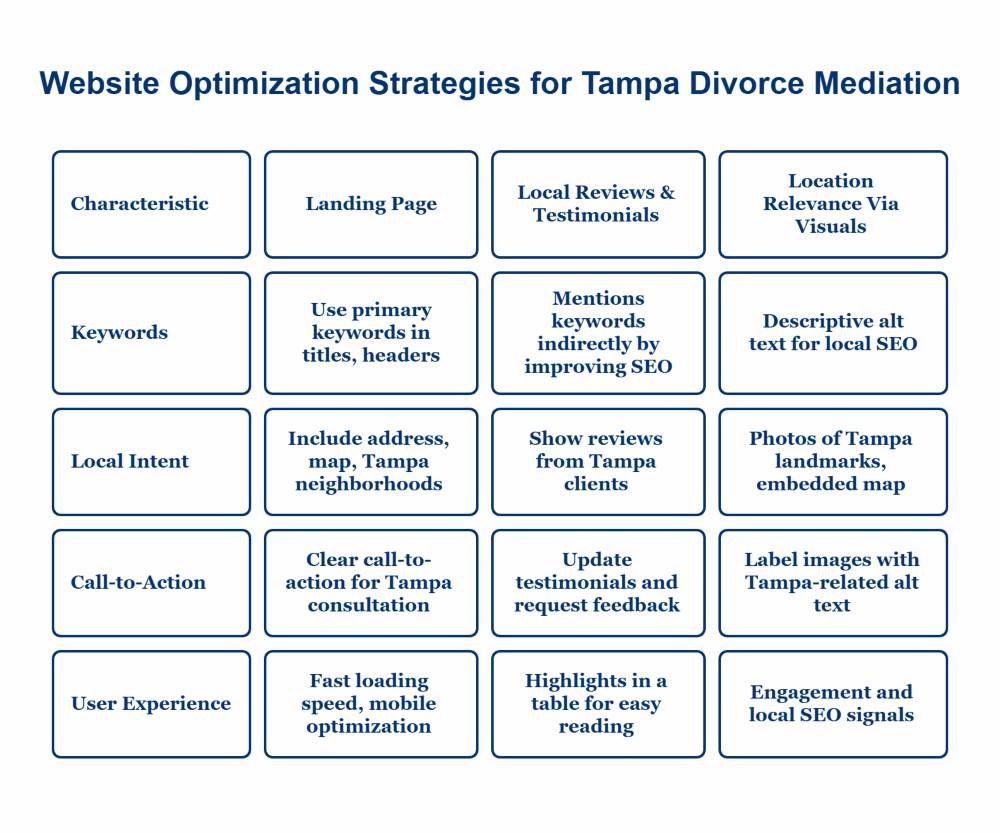
Website Optimization For Tampa Divorce Mediation Keywords
Optimizing a divorce mediator website for Tampa search queries takes more than just adding keywords.
Effective strategies focus on landing pages, social proof, and highlighting local relevance to increase visibility and conversions.
Build A Tampa Landing Page That Converts
A targeted landing page is essential for local search traffic. It should utilize primary keywords, such as “Tampa divorce mediation” and “divorce mediator Tampa,” in the title, header tags, and main content.
Local intent matters—include the office address, interactive map, and Tampa neighborhoods served. List services in bullet points to improve skimmability:
Divorce mediation sessions
Virtual consultations
Flexible scheduling around Tampa courts
Add a straightforward call-to-action such as “Schedule Your Free Tampa Consultation.” Fast loading speed and mobile optimization are important, as most people search on their phones.
Embed Local Reviews & Testimonials
Displaying reviews from Tampa clients can build immediate trust with new visitors. Show real names, photos (with permission), and details like “Mediated amicably near South Tampa.”
Utilize embedded widgets from Google or Facebook to enhance authenticity.
Include review highlights in a table for easy reading:
Reviewer
Location
Feedback
Sarah M.
Westchase
“Smooth process and caring mediator.”
Felix R.
Channelside
“Quick resolution close to downtown.”
Update testimonials often and remind happy clients to leave feedback.
Visual content supports a stronger local identity.
Add photos of the office exterior, staff with Tampa landmarks, and meeting spaces.
Include images of familiar sites, such as the Tampa Riverwalk or the courthouse, to establish a connection.
Use an embedded map showing the exact location.
When possible, include infographics showing the mediation process for Tampa residents.
This helps with both engagement and local SEO signals.
Properly label all images with descriptive alt text, such as “Tampa divorce mediation office near Hyde Park.”
This step helps search engines understand the local connection and improves accessibility for all users.
Don’t let your competitors dominate Google Maps listings. 800Commerce’s Google Business Profile optimization helps Tampa mediators get seen and get chosen. Contact us to schedule a quick consultation.
Getting More Reviews & Engagement In The Tampa Market
Earning more online reviews can be a powerful tool for a divorce mediation business in Tampa.
Genuine feedback builds trust with potential clients and improves local SEO rankings, helping mediators stand out in search results.
Automate Review Requests After Sessions
Making it easy for clients to leave a review is key. Divorce mediators in Tampa can set up automated systems that send a gentle follow-up email or text after every mediation session.
These messages should include a direct link to the business’s Google or Facebook review page.
Offer a brief, polite message thanking the client for choosing your services and politely requesting feedback.
Automation helps ensure that every client gets a reminder, not just the happy ones.
This leads to a steady flow of reviews, making the mediator appear more credible and active online.
Using review automation can also save staff time and reduce the chance of forgetting to ask clients.
Many Tampa mediation businesses use platforms like Birdeye, Podium, or even Google’s free review link generator.
Timely review requests significantly increase response rates and support growth for those seeking to attract more divorce mediation clients in Tampa.
Respond To All Reviews—Positive & Negative
Divorce mediators need to respond to every review, regardless of whether the feedback is positive or negative.
Thanking a client for a positive review demonstrates appreciation and fosters loyalty.
A polite and professional response to a negative review demonstrates to others that the business values improvement.
Responding to negative feedback should include a brief apology and a request to discuss the concern privately.
This helps protect privacy and signals to future clients that the mediator values transparency and integrity. Additionally, businesses that respond to active reviews are more likely to be favored by search engines. Search engines favor businesses with active review responses.
Make sure all replies are timely, personal, and professional.
Regular engagement with reviews improves reputation and is a popular review strategy for divorce mediators in competitive markets like Tampa.
Use Reviews As Content
Reviews can double as powerful marketing content.
Mediators can display selected positive quotes from clients (with their permission) on their website, social media, and printed materials.
Sharing a few standout testimonials in email newsletters can help establish a connection with potential clients and foster trust.
Create a dedicated reviews page or section on your website.
This not only demonstrates transparency but also provides keyword-rich content that enhances local SEO for a Tampa mediation business.
Quotes from real clients make your website feel more authentic and credible.
Consider using a table to organize and display reviews, listing the review date, the reviewer’s first name, a short quote, and the star rating.
This structured layout is easy to read and can help highlight the business’s strengths when people are deciding which Tampa mediator to choose.
Tracking Performance: How To Know You’re Winning
Divorce mediators in Tampa need clear data to measure SEO results.
Tracking the right metrics with effective tools is key for improving digital visibility and attracting more clients.
Top Tools For Divorce Mediation SEO Tracking
Local mediators benefit from specialized tools that offer precise tracking of Google Maps and local search positions.
Platforms such as Local Falcon, Places Scout, and Semrush Local let firms see how they rank in Tampa neighborhoods or zip codes.
Geo-grid map capabilities show ranking changes block by block, making it easier to see where optimization is working.
Some free tools, such as the Localo rank checker, allow for quick spot checks of specific keywords and locations.
Tools like Wincher enable the tracking of rankings for both standard and map results, making them ideal for local businesses focused on improving their Google visibility.
Regular use of these rank trackers helps mediators identify gaps and areas for improvement in their local SEO strategy.
Reliable reporting features also support sharing clear outcomes with the team or management.
Metrics To Monitor
It is important to track key metrics that reflect both visibility and user actions.
Location-based keyword rankings show how often a firm’s website appears for divorce mediation searches in Tampa.
Firms should monitor impressions and clicks from their Google Business Profile to gauge the success of their local listings.
Conversion numbers, such as calls, messages, and contact form submissions from the website or listings, indicate whether the SEO strategy is attracting potential clients.
Site traffic growth from organic searches is another positive sign, especially if it comes from searches tied to Tampa divorce mediation.
Tracking reviews and ratings on local platforms is also important.
A steady rise in positive feedback often coincides with improvements in search rankings and increased client trust.
Common SEO Pitfalls For Mediators To Avoid
One major mistake is focusing solely on rankings and overlooking conversions. High search rankings are valuable, but without generating calls or leads, the effort does not yield a return on investment.
Some mediators focus on broad keywords rather than location-specific ones that clients typically use.
Failing to address or ignore negative reviews publicly can damage trust and reduce visibility in local search results.
Skipping regular monitoring due to time constraints or a lack of understanding allows minor issues to escalate into significant problems.
Finally, using only one tracking tool or outdated methods, instead of modern tools with geo-specific tracking, limits a firm’s insight into how well campaigns are performing.
Careful monitoring helps avoid these errors and ensures successful SEO efforts.
Conclusion
Ranking at the top of Google results in Tampa requires both patience and consistent local SEO efforts.
Divorce mediators see better results by targeting keywords that clients use.
Key Takeaways:
Keep Google Business Profile updated
Collect positive reviews from satisfied clients
Use location-based keywords in high-value website pages
Optimizing online presence goes beyond just a website.
Social media, trustworthy local directories, and positive testimonials work together to strengthen a reputation.
Useful tips from sites such as MediatorLocal highlight the importance of a holistic approach.
It helps to check progress regularly. Track keyword rankings, website visits, and how often clients reach out through online channels.
Providing prompt answers to potential client questions builds trust and sets mediators apart from competitors.
Staying informed about new local SEO trends gives mediators valuable insights.
They can adapt strategies by reviewing articles, such as those on Transformational Outsourcing, to remain visible in search results.
If your phone isn’t ringing, your local SEO may be to blame. 800Commerce designs targeted local marketing plans just for mediation firms. Contact us now to schedule your discovery call.
Frequently Asked Questions
What is local SEO for divorce mediators?
Local SEO helps divorce mediators appear in search results when potential clients look for services nearby. It involves optimizing your Google Business Profile, utilizing local keywords such as “Tampa divorce mediation,” soliciting reviews, and securing local backlinks to enhance visibility on Google Maps and search engine listings.
How can a divorce mediator rank #1 on Google in Tampa?
To rank #1 on Google in Tampa, a divorce mediator needs an optimized Google Business Profile, consistent NAP citations, localized content, and quality backlinks. Regular reviews and proximity to the searcher also influence your placement in the local pack.
Why is Google Business Profile important for Tampa mediators?
Google Business Profile helps mediators appear in the top local results on Google Maps and search. A comprehensive profile, complete with reviews, service categories, hours, and local images, builds trust and drives clicks from Tampa residents searching for divorce assistance.
What keywords should Tampa mediators use for SEO?
Tampa mediators should utilize local, service-based keywords such as “Tampa divorce mediator,” “amicable divorce Tampa,” and “child custody mediation near me.” Including these naturally in your website, headers, and metadata helps Google match your business to relevant searches.
How do online reviews affect local SEO for mediators?
Positive reviews improve trust and signal to Google that your mediation service is credible and active. More reviews—especially with location mentions like “in Tampa”—can help boost your local rankings and client conversion rate.
Divorce professionals in Florida face a unique challenge in connecting with new clients and building trust within their communities.
Google Business Profile gives divorce lawyers, mediators, and related experts a way to stand out on Google Search and Maps, making it easier for clients to find reliable help when they need it most.
With the right strategies, Florida divorce professionals can manage their online presence and highlight their expertise. They can attract more local clients using this free tool.
Optimizing a Google Business Profile helps professionals appear in local searches and respond to client reviews.
It also allows them to share important updates. This level of online visibility is essential in a competitive field where reputation means everything.
To succeed, it’s not just about being listed—it’s about using every feature to its fullest potential.
Professionals can optimize their profiles to showcase their specialties and address common questions. They can build trust with important details.
Key Takeaway:
Google Business Profile (formerly Google My Business) is the #1 tool for increasing local visibility and attracting divorce clients in Florida without paid ads.
Fully optimized profiles rank higher in Google’s Map Pack and Search results, leading to more calls, website clicks, and consultations.
Consistent reviews, detailed service listings, and Florida-specific content help your profile stand out and build trust fast.
Ongoing updates and local SEO signals (like legal directory listings and weekly Google Posts) keep your profile active and ranking over time.
Why Google Business Profile Matters For Florida Divorce Pros
Success for divorce professionals in Florida often depends on local visibility and a strong online presence.
Google Business Profile helps lawyers connect with people who are searching for divorce assistance in their area.
Most Local Legal Searches Begin On Google
Nearly every person seeking a divorce lawyer in Florida begins their search using Google. Over 90% of online experiences start with a search engine.
For local services like legal assistance, people typically add city names or terms like “near me” to find a provider nearby.
When divorce professionals in Florida set up and optimize their GBP profile, they show up in these highly targeted local searches.
A current profile helps ensure that details like address, phone number, and hours are accurate.
This is especially important since people searching for a lawyer want quick answers and easy ways to get in touch.
Google makes it simple for potential clients to call, message, or get directions straight from the Google Business Profile listing.
This reduces friction and encourages more inquiries.
Having up-to-date information also shows that the law firm is active and ready to help.
Map Pack Dominates Clicks
The “Map Pack”—the set of three business listings with a map at the top of Google’s search results—is a major driver of leads for Florida divorce lawyers.
When someone searches for “divorce lawyer Florida,” Google’s local pack pulls the highest quality and most relevant Google Business profiles based on proximity, reviews, and profile completeness.
Listings that appear in the map pack get the majority of clicks, sometimes as much as 46% of all local search traffic.
Legal professionals without a well-maintained Google Business Profile are less likely to show up here, meaning fewer potential clients will find them.
To maximize visibility in the Google Business Profile local pack, divorce professionals should ensure their information is accurate and utilize relevant categories.
Posting updates or photos and regular engagement on the profile signals to Google that the lawyer is responsive and reputable.
Trust Through Visibility & Reviews
Trust is a top concern for anyone facing a challenging legal situation, such as divorce.
Prospective clients want to see that a divorce professional is respected and reliable before seeking help.
Google Business Profile enables law firms to establish trust in several key ways.
Being visible in local search, especially in the local pack, creates the impression that the firm is recognized and established.
Positive client feedback and thoughtful responses to reviews instill confidence in a law firm’s reputation among new clients.
Florida divorce lawyers who encourage satisfied clients to leave honest reviews and respond politely to feedback can further increase trust.
Google Business Profile for lawyers also allows posting of photos, services, and FAQs, adding extra transparency that can help people choose one provider over another.
Google Business Profile Setup Essentials For Divorce Law Practices
Getting the basics right with Google Business Profile is key for divorce professionals in Florida.
The Name, Address, and Phone Number (NAP) on a Google Business Profile must match exactly with what appears on the firm’s website and local directories.
Inconsistencies can confuse Google’s system and lower search visibility.
Firms should list the full legal business name, not abbreviations or extra keywords.
The address must be a physical location in Florida suitable for serving clients, not a P.O. Box or virtual office.
A direct office phone number is required—avoid call centers or generic lines.
It is helpful to check major legal directories, the firm’s website, and the local Bar listing to ensure NAP details are consistent across all platforms.
This consistency helps Google verify the business and improves map listings for Google Business Profile for divorce professionals in Florida.
Choose The Right Categories
Selecting the correct business category connects a divorce practice with potential clients searching for those services.
“Divorce lawyer” or “Family law attorney” are the most relevant GBP categories for these firms.
The main category should stay as specific as possible.
Subcategories can be added, but avoid unrelated services that may confuse users or lower ranking.
This supports the practice’s appearance in the right search results for “divorce lawyer Florida” or “family law attorney Florida.”
Only use categories that match the legal services offered.
Complete Your Profile Details
A complete Google Business Profile profile builds trust with both clients and search engines.
Carefully fill out business hours, website URL, areas served, service descriptions, and accepted payment methods.
Profile visuals are important. Upload a clear logo, professional headshots, and high-quality photos of the office.
Service descriptions should clearly outline specialties, such as “Child Custody,” “Alimony Consultation,” or “High-Asset Divorce.”
Answers to common questions—like consultations, languages spoken, or parking—can be added to the Q&A section.
Detailed profiles increase the likelihood of ranking higher and provide valuable information to clients seeking a GBP category divorce lawyer in Florida.
Want your Florida divorce practice to show up on Google Maps when clients search? 800Commerce will optimize your Google Business Profile from the ground up. Contact us to schedule your audit.
Optimization Tactics For Maximum Visibility
Divorce professionals in Florida can expand their local reach and attract more clients by taking practical steps that go beyond simply filling out a basic profile.
These methods directly boost local search rankings and make a profile appealing to potential clients.
Geo-Tag Photos & Local Posts
Geo-tagged photos play an essential role in the optimization process. When a Florida divorce lawyer uploads images with embedded location data, Google can better connect the Google Business Profile listing to local searches.
Use recent pictures of the office, staff, and relevant legal documents that include visible location details.
Regular posting about local divorce mediation events, Florida custody law updates, or community outreach will show both relevance and activity.
For example, posts like “Free Consultation Saturday in Miami” or “Recent Court Decision on Alimony in Tampa” help tie the service to specific cities.
Tips for Geo-Tagged Content:
Use a smartphone with location settings on.
Add geo-tag details before uploading.
Use captions with specific Florida cities or counties.
Display actual work and client meetings (respecting client privacy).
This approach strengthens Google’s trust signals and improves the listing’s ability to rank for local keywords such as “divorce attorney FL” and “divorce mediation FL”.
Implement GBP Q&A And Google Posts
The Q&A function is often overlooked, but it gives control over the information future clients see.
Florida divorce lawyers should frequently ask and answer questions they receive, such as “How much does a divorce cost in Florida?” or “What documents are needed for mediation?”
Add at least 5-7 common questions with clear, helpful answers.
Maintaining Google Posts is also important.
These updates can include brief news items, legal tips, testimonials, or event reminders related to Florida divorce law.
Each post should utilize local, relevant keywords and include calls to action, such as “Schedule Your Consultation.”
Details to Consider:
Review the Q&A weekly to address new queries.
Use Google Posts for time-sensitive info (example: holiday office closures).
Link to detailed resources or blogs when needed.
Drive & Manage Reviews Effectively
Reviews are a high-impact local SEO factor for any divorce attorney in Florida.
Encourage every client to leave an honest review by sending a follow-up email or text with a direct review link immediately after their case is completed.
Reply to all reviews—both positive and negative—with professionalism and empathy.
Build trust by thanking reviewers and addressing complaints quickly. Inviting further discussion offline when necessary is also helpful.
Highlighting specific services, such as mediation or custody consultations, in review replies can also reinforce niche expertise.
Key Points for Managing Reviews:
Create a step-by-step review request template.
Monitor the listing daily for new feedback.
Use recent testimonials in Google Posts and on the firm’s website.
Boosting Local Authority Beyond GBP
Florida divorce professionals can stand out in local search by strengthening their authority across the web.
This means earning mentions from trusted directories, high-value websites, and connecting with the local community through tailored content.
Build Florida-Focused Citations
Building consistent citations on Florida-focused directories helps divorce professionals appear more prominently in local search results.
List the practice on reputable legal directories such as the Florida Bar Association, Justia, and Avvo, as well as specialized Florida legal directory citations.
Every listing should match the business name, address, and phone number exactly.
Maintaining up-to-date profiles adds further credibility.
Use categories and descriptions that clarify a focus on divorce, family law, or related legal services in Florida.
Consistent and complete citations signal trustworthiness to both search engines and clients.
Encourage High-Quality Backlinks
High-quality backlinks remain a critical factor for local SEO for Florida divorce professionals.
Focus first on connections with local organizations and Florida legal groups.
Offer to write guest articles for respected law blogs, Florida business associations, or community media sites.
Links from these sources carry more weight than random directories.
Backing up expertise with published work or commentary on Florida divorce law increases authority.
Partner with local nonprofits, bar groups, or event hosts to be featured on their websites. And social media platforms
Look for opportunities to share client success stories or firm achievements for additional mentions and links back to the website.
Cover topics unique to Florida law, such as residency requirements, alimony rules, or changes to divorce statutes.
Simple guides, FAQs, and updates make the firm visible and useful to people searching in the area.
Promoting participation in local events or seminars also helps.
For example, share highlights from community workshops or post announcements about speaking at regional conferences.
Adding images, testimonials, and details about involvement shows commitment and relevance to the Florida community.
If your profile isn’t fully optimized, you’re missing local leads. 800Commerce assists Florida divorce professionals in updating categories, services, and reviews on Google Business Profile. Contact us now to schedule a review of your listing.
Measuring ROI: Tracking Your GBP Performance
To prove the value of Google Business Profile, divorce professionals in Florida need data to support their claims.
Monitoring the right performance metrics enables offices to identify what drives leads and track meaningful results.
GBP Insights Dashboard Use
The GBP Insights dashboard provides a clear overview of how clients find and interact with a profile.
Divorce professionals can track searches, website clicks, direction requests, and phone calls.
For Florida mediators, it is especially important to track Google Business Profile calls, since many consultations begin over the phone.
Profile activity, such as post views and appointment bookings, can also be monitored.
The dashboard updates monthly and displays queries that led users to the business, enabling firms to identify the search terms that perform best.
Understanding these stats helps legal services in Florida measure click-through rates, track visibility in local search, and identify peak periods for engagement.
Accurate tracking means more informed decisions about content and ad spend.
UTM & Analytics Integration
To go beyond basic stats, Florida divorce professionals can use UTM codes with their GBP links.
Adding UTM parameters to website URLs enables Google Analytics to accurately track the number of visitors coming from the business profile.
This supports tracking not only site visits, but also completed goals, such as lead forms or chat requests.
Google Analytics integration also shows session durations, bounce rates, and conversion paths for GBP traffic.
Legal firms can see the quality of leads and compare performance with other channels.
For those advertising multiple services, UTM tagging can differentiate mediation inquiries from divorce consultations.
UTM links are created using free tools and then added to the Google Ads platform (GBP). Accurate implementation is key for reliable reporting.
Set Timeline & Goals
Setting timeframes and clear goals ensures that data is actionable and useful. Florida legal services should establish a reporting schedule, with monthly or quarterly reviews typically being effective for most firms.
Tracking stats like call volume, direction requests, and website clicks will reveal trends over time. Goals should be specific and tied to business outcomes.
For example, a divorce office might set targets for new client consultations based on calls from the Government’s Budget Plan (GBP).
Comparing results against past performance helps identify successful strategies.
Use simple tables to track metrics each cycle:
Metric
Month 1
Month 2
Month 3
Website Clicks
32
44
51
Google Business Profile Calls
12
19
17
Direction Requests
8
18
13
Regular tracking supports smarter marketing decisions and helps maximize return on investment.
Common GBP Mistakes & Quick Fixes
Mistakes on Google Business Profile (GBP) can lower a Florida divorce attorney’s credibility and limit their reach in local searches.
Many errors can be easily avoided through routine profile checks, careful business information management, and effective review strategies.
Ignoring Verification Or Duplicate Listings
Failing to verify a GBP means the divorce law firm will not appear in primary Google searches or on Google Maps.
This can result in fewer calls and website visits.
Duplicate listings happen when the same address or phone number is used for multiple profiles.
This confuses both clients and Google, leading to lost visibility or even profile suspension.
A divorce attorney can use Google’s search tools to check for duplicate profiles, then report or remove them.
To resolve issues, please complete the verification process as soon as possible.
Regularly look for and remove any duplicate entries.
This builds trust and helps the profile rank higher in local results.
Combining this with schema markup for a divorce attorney in FL improves accuracy in search engine results.
Keyword Stuffing In Business Name
Some professionals add too many keywords to their business name on GBP, for example, “Miami Divorce Lawyer – Best Family Legal Services Florida.”
While this may seem helpful, it can result in the profile being flagged or suspended.
Google’s guidelines require the business name to match a real-world business name.
Overusing keywords is perceived as manipulative and can negatively impact the attorney’s local search ranking.
Clients may also feel the listing is less trustworthy. To correct this, use only the official business name.
If keywords are important, include them in the business description or add schema markup for divorce attorneys in Florida on the firm’s website.
This keeps the GBP within Google’s policies and helps attract the right clients.
Neglecting Review Management
For Florida divorce professionals, client reviews are crucial to online reputation. Ignoring reviews—positive or negative—can make a firm look inattentive.
Establish a straightforward review management process, such as sending weekly reminders to review the profile. This helps boost the firm’s visibility and trust.
For attorneys using GBP, review management should be part of regular profile audits, as it can help them stand out from competitors, especially in crowded Florida markets.
Conclusion
Google Business Profile is a vital tool for Florida divorce professionals. It makes it easier for potential clients to find accurate information about services, hours, and contact details.
A well-optimized Google Business Profile listing improves local search results. Divorce lawyers and firms gain more visibility in searches performed by people in their area.
A complete profile with updated photos and verified contact information can help professionals make a strong impression. Active management, such as responding promptly to reviews and providing regular updates, demonstrates a commitment to client service.
Keeping information clear and current on Google Business Profile supports local SEO efforts. This helps Florida divorce professionals connect with individuals seeking legal guidance in their local area.
Clear profiles, active engagement, and trustworthy reviews are key building blocks for success.
Google Business Profile is your first impression—make it count. 800Commerce helps Florida divorce lawyers build listings that convert. Contact us today to schedule your local growth strategy session.
Frequently Asked Questions
What is Google Business Profile, and why does it matter for divorce professionals in Florida?
Google Business Profile (formerly Google My Business) is a free tool that helps Florida divorce professionals appear in local search results and on Google Maps. A complete, optimized profile builds trust and attracts more qualified leads.
How can a Florida divorce attorney optimize their Google Business Profile?
Complete every section of your Google Business Profile, including categories, services, hours, photos, and reviews. Regular updates help boost your visibility in Florida’s competitive legal market.
Does choosing the right category on Google Business Profile affect rankings?
Yes. Selecting specific categories, such as “Divorce Lawyer,” instead of just “Lawyer,” helps Google match your listing with people searching for divorce-related services in Florida.
How do online reviews on Google Business Profile impact my ranking?
More 5-star reviews on your Google Business Profile can significantly improve your position in local results. Google values recent, relevant, and location-specific feedback.
How often should divorce professionals post on Google Business Profile?
Posting weekly on Google Business Profile keeps your listing active and demonstrates to Google that you’re engaged. Share updates about services, FAQs, or Florida family law news.
Can I track leads from my Google Business Profile?
Yes. Google Business Profile Insights shows calls, website clicks, and directions. You can also add UTM codes to track performance through Google Analytics.
The colors on your mediation website do more than just look good—they shape how visitors feel, whether they trust you, and even whether they reach out for help.
Selecting the right color palette helps your website set a calming, professional tone, which is important for anyone seeking mediation services.
Different colors stir up different emotions. Blues and greens might remind people of peace and safety, while warmer colors could spark energy or maybe even caution.
Understanding color psychology helps your site stand out and makes visitors feel comfortable from the first second.
When your palette matches your desired mood, people tend to stick around, remember your brand, and maybe even reach out for support.
Key Takeaways
The right color palette builds trust and comfort for visitors
Color choices can influence how people feel and interact with your brand
Using color psychology helps your mediation website stand out and succeed
Why Color Psychology Matters In Mediation Marketing
The colors on your mediation website shape how people feel about your services. Using smart color psychology in legal web design helps you connect with clients and build instant trust.
First Impressions Influence Emotional Safety
Colors hit our emotions in seconds. When someone lands on your site, your color palette instantly makes them feel comfortable—or not.
In mediation branding design, calm shades like soft blues, gentle greens, and neutrals help people breathe a little easier.
A well-chosen color scheme can lower anxiety and make it easier for clients to explore what you offer. People searching for mediation are often stressed or uncertain.
Soft colors quietly signal that your services are welcoming, neutral, and safe.
Key tips:
Stick with a consistent palette for headers, buttons, and backgrounds.
Avoid harsh contrasts or super-bright reds—they can ramp up stress.
Test different colors with real users to see which ones get the best reactions.
Building A Trustworthy Online Presence
Trust matters a lot in mediation. The best legal website color branding tips focus on colors that show professionalism and reliability.
Blue often gets linked with trust and stability, while muted earth tones feel dependable.
A strong color palette also helps people remember your brand. Research even says color can boost brand recognition by up to 80%.
Consistency in your colors—logos, CTAs, menus—lets people know they’re in the right place.
Pick two or three main colors and use them everywhere on your site.
Leave plenty of white space for a clean, inviting look.
Skip trendy colors that don’t fit legal or mediation fields, like neon green.
How Color Affects Emotions And Perceived Trust
Color choices can impact how visitors feel about your mediation website. The right palette can help people relax and feel they can trust you.
Neuroscience Of Color In Conflict Resolution
Your brain responds to colors almost instantly. Certain colors, like blues and greens, spark areas in the brain tied to calmness and safety.
These shades work well in conflict resolution settings, lowering stress and encouraging thoughtful communication.
Neutrals like soft gray or tan also support a calming UI for mediation services. Legal websites often use these tones to help people feel less anxious while searching for help.
Blue stands out as a trust-building color for websites. It signals dependability and honesty, which is why it is used on many mediation sites.
Yellows and oranges can bring optimism, but it’s easy to overdo it. Too much can feel overwhelming or even unprofessional.
Finding the right balance increases the odds that users will feel comfortable opening up and working toward a resolution.
Warm Vs. Cool Tones In The Mediation Context
Warm colors like red or bright orange inspire energy but might also cause tension or urgency. Red can signal a warning, which isn’t always helpful in mediation.
Too many warm tones might distract or even put off clients who want a peaceful solution.
Cool tones—especially blue and green—work as calming website colors for mediators. They help create a peaceful digital space that makes clients feel welcome.
Cool colors foster trust and connect with professionalism in legal branding. Green, for example, represents growth and balance, which is perfect for those seeking resolution.
Want your mediation website to build instant trust? 800Commerce can design a calm, professional color palette that speaks volumes to potential clients before they even read a word. Reach out today.
Here’s a quick table showing how common colors are perceived in mediation website design:
Color
Emotion
Usefulness
Blue
Trust, calm
Builds trust
Green
Balance, growth
Calms, reassures
Gray
Neutral, steady
Soothes anxiety
Yellow
Optimism, warmth
Use with care
Red
Urgency, energy
Use sparingly
Interpreting Color Associations For Mediators
Picking the right colors for your mediation website helps set the right mood and supports your message. Each color brings a unique vibe and can influence how potential clients see your services.
Blue – Calm, Professionalism, Reliability
Mediators and legal professionals frequently use blue because it evokes calm, trust, and reliability. Using blue on your site makes visitors feel more at ease and shows you’re serious about helping them resolve conflicts.
A palette built around blue suggests transparency and professionalism—exactly what clients want in a mediator. Soft blue backgrounds or accents can reduce stress and help create order and structure.
If you want your site to look credible and inviting, blue is a safe bet. It’s also the top pick for many legal and mediation websites that aim for a welcoming but professional space.
Green – Balance, Stability, And Renewal
Green is the color of new beginnings, balance, and stability. In mediation, green is a smart choice because it sends a peaceful message and encourages positive change.
Green reduces anxiety, which is key for clients dealing with conflict or stress. It also symbolizes growth, harmony, and resolution—important goals for any mediation practice.
Lighter greens give a gentle feel, while deeper tones add reassurance. Green makes a strong case for mediation services focused on stability and renewal..
Neutral Tones – Objectivity And Warmth
Neutral colors like gray, beige, and soft whites create a background that projects objectivity and warmth. They don’t distract from your content and show that your practice is unbiased and non-judgmental.
You can pair neutral backgrounds with stronger accent colors to keep your design simple and approachable. A neutral color palette for lawyers helps your site appeal to a wider range of clients by avoiding strong emotional signals.
Neutrals make your website look modern and clean. They increase readability and draw attention to what matters most.
When used well, they support a calm, open environment where visitors feel comfortable and heard.
Purple Or Teal – Sophistication Or Empathy
Purple brings sophistication, wisdom, and creativity. It can show that your mediation practice offers thoughtful solutions and expertise.
Rich purples work well in accents, headlines, or calls to action if you want to highlight uniqueness or special services.
Teal blends the stability of blue with the renewal of green, making it great for mediators who want to show empathy and clarity. It gives off an open and caring attitude, which helps create emotional comfort for clients.
Purple and teal aren’t as common as blue or green, so they help you stand out. Used thoughtfully, they make your practice memorable and approachable for people seeking unique solutions.
If you focus on emotional support or specialized services, purple or teal can highlight your strengths in an emotional color strategy for mediation practices.
How To Build A Strategic Color Palette
Choosing your website colors sets the mood and affects how people feel and act when they visit. Color should fit your audience, reinforce trust, and support your goals in online mediation.
Identify Your Primary Audience
Knowing your audience really helps you pick colors that fit their expectations and comfort zones. A mediation website usually aims for calm, trust, and neutrality.
Blue is popular for its association with peace and reliability. If your audience is experiencing conflict or stress, try soft greens, cool blues, and gentle neutrals.
These are often the best colors for mediation websites because they avoid harshness and don’t trigger anxiety.
Check out what your competitors use and consider your unique approach. If your mediation service focuses on families, lighter tones might work best.
For business-focused platforms, you could add subtle grays or muted golds for a more professional feel. Adjust your colors based on what helps your audience feel safe and heard.
Apply The 60-30-10 Design Rule
A balanced color palette just feels right. It’s easier on the eyes and instantly looks more professional.
The 60-30-10 rule is a classic design strategy for managing your website’s visual hierarchy without overthinking it.
60%: Dominant Color (backgrounds or main sections; go for a calming shade—think soft blue or light gray—to set a peaceful tone)
30%: Secondary Color (headers, sidebars, or cards; maybe a gentle green, beige, or muted teal for some variety, but still keep it neutral)
10%: Accent Color (buttons or links; a subtle coral or gold adds a pop of interest and pulls the eye where you want it, but doesn’t steal the show)
Try to stick to three main colors. It’s easy to get carried away, but more than that, it usually leads to clutter and confusion, especially for the best UX colors on conflict resolution sites.
Too many bold or bright hues can feel aggressive or out of place. Less really is more here.
A/B Test Color Impact On Engagement
Once you’ve picked your palette, don’t just hope it works—test it out. Even small color tweaks can shift how people interact with your site.
Run A/B tests by showing users different color versions. Then, measure things like session time, clicks, or form completions.
For example, maybe blue buttons get more consultation bookings, or a certain background shade keeps people around longer. It’s worth experimenting.
Look at both the numbers and what users say. Sometimes the data tells one story, but feedback adds another layer of insight.
This is key when choosing a mediation site color palette that feels professional but still inviting.
Colors influence perception more than you think. Let 800Commerce help you align visual tone with your mediation brand’s values and boost conversions without saying a word.
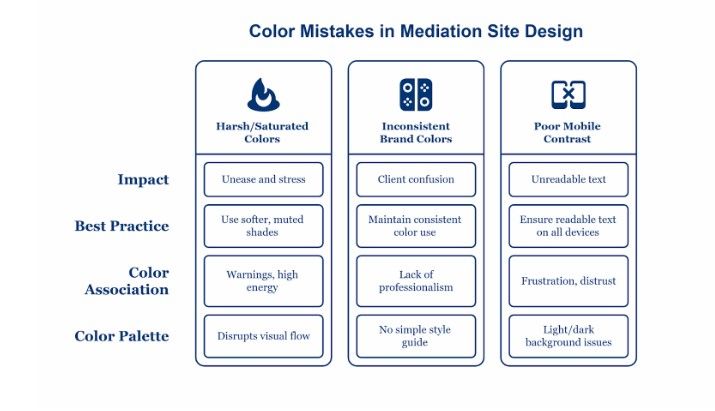
Common Mistakes To Avoid In Mediation Site Design
A professional mediation website needs a color palette that’s welcoming, calming, and matches your brand.
The right colors help build trust, but the wrong ones can hurt user experience and even block accessibility.
Using Harsh Or Saturated Colors
Bright reds, neon blues, or super-saturated greens grab attention but often make visitors uneasy or stressed.
Those colors are linked to warnings or high energy, not what someone wants when they’re seeking family law or divorce help.
Mediation websites work best with softer, muted shades, especially for family and divorce. Pale blues, gentle greens, and earthy neutrals set a reassuring mood.
These colors connect with calm and trust, which matters in legal and mediation settings. Using too many bold colors simultaneously disrupts visual flow and distracts from the important stuff.
Limiting your palette to a few colors keeps your site focused and professional.
Inconsistency Across Brand Assets
If your website, business cards, and social profiles don’t match, clients get confused. Consistent color use builds trust and helps people remember you.
Pick one core color set and use it everywhere—on your website header, call-to-action buttons, or even your logo.
Look at the top family mediation sites for inspiration and notice how their colors carry across materials.
Make a simple style guide or table with your brand’s hex codes and usage examples. That way, everyone—web designers, social media folks—sticks to the same palette.
Consistency just feels more professional, and it makes your mediation business easier to recognize.
Ignoring Mobile Responsiveness In Color Contrast
Most people will check your site on their phones. Color combos that look great on a desktop might look bad on mobile.
Poor contrast between text and background can make things unreadable, especially for people with vision issues. Always double-check how your colors show up on both light and dark backgrounds.
Good website design for divorce mediators means text is readable, no matter the device. Follow accessibility guidelines for contrast—at least a 4.5:1 ratio for normal text.
Use tools like contrast checkers to spot issues early. Focusing on color accessibility in legal websites shows that you care about every client, regardless of their abilities or devices.
Testing color contrast might feel tedious, but it prevents frustration and helps build trust in your services.
Final Thoughts
Color does so much more than decorate your website—it sets the mood for everyone who visits. The palette you choose guides how people feel and react almost instantly.
Pick the right colors, and you might create a sense of calm, trust, or even openness. That first impression? It matters more than you think.
Think about emotions for a second. Soft blues and greens tend to bring peace or balance, while warmer shades like beige or muted gold. They can make your site feel cozy and welcoming.
Here are a few key questions to keep in mind when you’re picking colors:
Always keep your visitors’ experience in mind. If possible, test your palette with real users—sometimes the smallest tweaks matter. You make a stronger first impression when your color choices match your message.
Ready to make your mediation website look as neutral and reassuring as your services feel? Connect with 800Commerce for custom color branding that supports conflict resolution from the first click.
Frequently Asked Questions
What are the best colors for a mediation website?
Blue, green, and neutral tones are ideal for mediation websites. These colors evoke trust, calmness, and neutrality, which are essential for conflict resolution environments.
Why is color psychology important in mediation web design?
Color psychology shapes first impressions and emotional responses. Calming tones reduce anxiety and build trust, making potential clients more likely to engage with your mediation services.
How many colors should a professional mediation site use?
Use a three-color system: 60% for primary color, 30% for secondary, and 10% for accents. This creates a balanced and visually appealing user experience.
Should mediators avoid red or black color schemes?
Yes. Red and black can signal aggression, urgency, or dominance—emotions that conflict with the peaceful, neutral tone needed in mediation branding.
What color combinations build trust online?
Soft blues, muted greens, and warm neutrals are proven to increase feelings of trust, stability, and openness, making them effective for legal and mediation firms.
How does website color influence user behavior?
Color affects bounce rates, trust perception, and conversion rates. Calming palettes can increase time-on-site and improve lead generation for mediation practices.
Are color choices culturally sensitive in legal websites?
Yes. Colors like white, red, or purple carry different meanings across cultures. Mediation websites should prioritize cultural neutrality and accessibility when selecting a palette.
Mediation professionals need websites that do more than just share information. They must turn visitors into clients.
A well-designed mediation website can make a strong first impression. It encourages potential clients to take the next step.
When visitors land on a mediation website, they quickly decide if it feels trustworthy, clear, and helpful. Knowing which website elements help build that trust is key for any mediation practice looking to grow its client base.
1) Clear and Prominent Call-To-Action Buttons Guiding Clients to Book Mediation Sessions
A mediation website needs clear and easy-to-find Call-to-Action (CTA) buttons. These buttons guide visitors to book a session or contact the mediator.
Placing CTAs like “Book Your Session” or “Schedule a Consultation” at the top of the page helps visitors know what to do next.
A strong CTA stands out in both design and wording. It makes it easy for users to take action.
People are more likely to follow through when buttons use simple language and direct instructions. A button saying “Book Now” or “Start Mediation” avoids confusion and saves time.
Making the CTA button a different color from the rest of the page helps it get noticed. This approach draws attention and reduces guesswork.
800Commerce builds clean, responsive mediation websites that turn first impressions into scheduled sessions. From layout to CTA design, we handle it all. Are you ready to improve your site’s performance? Contact us today.
Client testimonials are a key part of building trust on a mediation website. Visitors want to see that real people have gone through the same process and found positive outcomes.
Testimonials share honest feedback about past experiences. This makes new visitors feel more confident in reaching out.
Short quotes or stories from past clients help show the impact of mediation. Testimonials work best when they mention specific results, like resolving a dispute quickly or improving communication.
Placing testimonials in a dedicated section or scattering quotes across the website works well. Featuring names, photos, or even video clips adds authenticity.
Potential clients can read or see these reviews to get a sense of what to expect, which helps them feel more comfortable moving forward.
Showcasing successful mediation stories is one of the best strategies to display testimonials. This element can turn someone from a site visitor into an actual client.
3) Professional and Approachable Mediator Profiles with Credentials
Visitors want to know who they’ll be working with. Professional mediator profiles help build trust and set expectations before the first contact.
A clear profile photo makes the mediator seem more approachable and relatable. Including a short biography with work experience and personal interests helps the mediator stand out.
Listing relevant qualifications, certifications, and training gives visitors confidence in the mediator’s skills. Details like years of experience, education, and areas of expertise show real value.
Profiles should avoid technical jargon. Simple language lets potential clients understand the mediator’s experience and role.
Visitors are more likely to read profiles when they are easy to find. Placing profiles on the homepage or about page can increase engagement and trust.
Your mediator profile and service pages won’t convert if no one finds them. 800Commerce offers targeted SEO for mediation firms to increase local visibility. Want more leads without ads? Schedule a strategy call.
4) Concise Explanation of Mediation Services and Process Benefits
A mediation website should give a clear explanation of what mediation services are. Mediation is a process where an unbiased third party helps people solve conflicts without going to court.
This simple description helps visitors understand if these services meet their needs. Explaining the main benefits of mediation builds trust.
Mediation is often faster and more cost-effective than litigation. Visitors appreciate that it prevents long legal battles and high costs.
Mediation gives parties more control over the outcome than a judge’s decision. The process is more private, and information stays confidential.
People can also save time since mediation usually ends sooner than court cases. Websites can list these benefits in a clear, bullet-point format or as short statements.
This makes the information easy to read. Moreover, describing the process and its advantages in simple terms makes the service more approachable.
This helps visitors feel more comfortable reaching out for help.
5) Live Chat Feature for Instant Visitor Engagement and Questions
A live chat feature lets visitors ask questions in real time. It helps answer concerns right away and can make potential clients feel supported.
This quick help can stop people from leaving the website just because they are confused. Many people prefer chatting over calling or emailing because it’s fast and easy.
Visitors can get answers about services, costs, or mediation in just a few minutes. Live chat can also guide visitors to the right page or resource.
This level of support can make a big difference in building trust. According to experts, adding live chat can increase the chance that visitors become clients.
A chat window should be easy to find but not intrusive. The chat agents should be friendly and professional. When visitors get quick help, they’re more likely to take the next step.
Understanding the Psychology of Conversion
Effective mediation websites use proven strategies to gain a visitor’s trust. They guide people toward becoming clients.
The role of psychology in website design focuses on visual appeal, credibility, and prompts that motivate people to take specific actions.
Building Trust Through Design
First impressions can decide whether a visitor stays or leaves. Sites with clean layouts, calming colors, and clear organization signal professionalism and care.
To create a sense of safety and reliability, designers choose consistent branding, display mediator credentials, and add real testimonials.
Easy-to-read contact details and privacy policies also matter. Simple, intuitive navigation helps users feel in control.
Avoiding clutter and using plenty of white space helps visitors focus.
Encouraging Action with Clear Calls-to-Action
To convert visitors into clients, mediation sites need easy-to-find and understand calls to action (CTAs).
CTAs like “Schedule a Consultation” or “Contact a Mediator” should stand out on the page and use direct, reassuring language.
Placing CTAs above the fold
Making buttons large and high-contrast
Using action words (e.g., Book Now, Get Started)
Too many requests or form fields can overwhelm users. Simple, specific CTAs make the next steps obvious and inviting.
For more on user behavior and conversion, see the psychology of website conversion optimization.
Your Google Business profile is often the first thing clients see. 800Commerce optimizes it to match your website’s messaging and improve local trust. Let’s get your profile working harder—contact us to begin.
Frequently Asked Questions
What are the essential features a mediation website should have?
Effective mediation websites include clear call-to-action buttons, client testimonials, professional mediator bios, simple service descriptions, and a live chat feature to answer user questions in real time.
How does website design impact mediation client conversions?
Clean layouts, mobile responsiveness, fast load times, and visually distinct CTA buttons help reduce bounce rates and increase user engagement, leading to more booked consultations.
What content builds credibility on a mediation website?
Client testimonials, detailed mediator profiles with credentials, transparent service explanations, and privacy policies help establish trust and professionalism with prospective clients.
Which CTA strategies work best for converting mediation clients?
Use action-based CTAs like “Book a Session” or “Schedule a Free Consultation,” positioned at the top of the page and after key content. Test different wording and button colors to improve results.
Why is mobile responsiveness crucial for mediation websites?
A mobile-friendly website ensures fast loading, easy navigation, and readable content on all devices, boosting mobile users’ engagement and conversion rates.
What user experience (UX) best practices increase conversions?
Fast page speed, intuitive navigation, live chat, and well-placed contact forms create a frictionless experience. Breaking content into sections with clear headings improves readability and engagement.
How can visuals improve a mediation website’s performance?
Professional photos, calming color palettes, and trust-building graphics enhance user confidence. Visual cues like arrow icons or button hover effects guide visitors toward taking action.
If people can’t find you online, do you even exist?
Imagine someone in desperate need of a mediator. They type “best mediator near me” into Google. But instead of finding you, they see your competitors at the top. Frustrating, right?
Here’s the truth: 75% of people never scroll past the first page of Google (Backlinko, 2023). That means potential clients are choosing someone else if your website isn’t ranking well.But here’s the good news: SEO (Search Engine Optimization) can help you climb the rankings, attract more clients, and establish yourself as a trusted expert.
. A well-optimized website means:
More people finding your services
More calls and inquiries from potential clients
Less reliance on costly ads
You don’t need to be a tech genius to make SEO work for you. With the right strategies, your mediation practice can become the first choice for those searching online.
Let’s get started!
Key Takeaways
Strategic SEO optimization helps mediator websites rank higher in search results without requiring expensive marketing campaigns.
Local SEO techniques connect mediators with nearby clients actively searching for conflict resolution services.
Creating informative, targeted content improves search visibility while establishing professional authority in specific mediation niches.
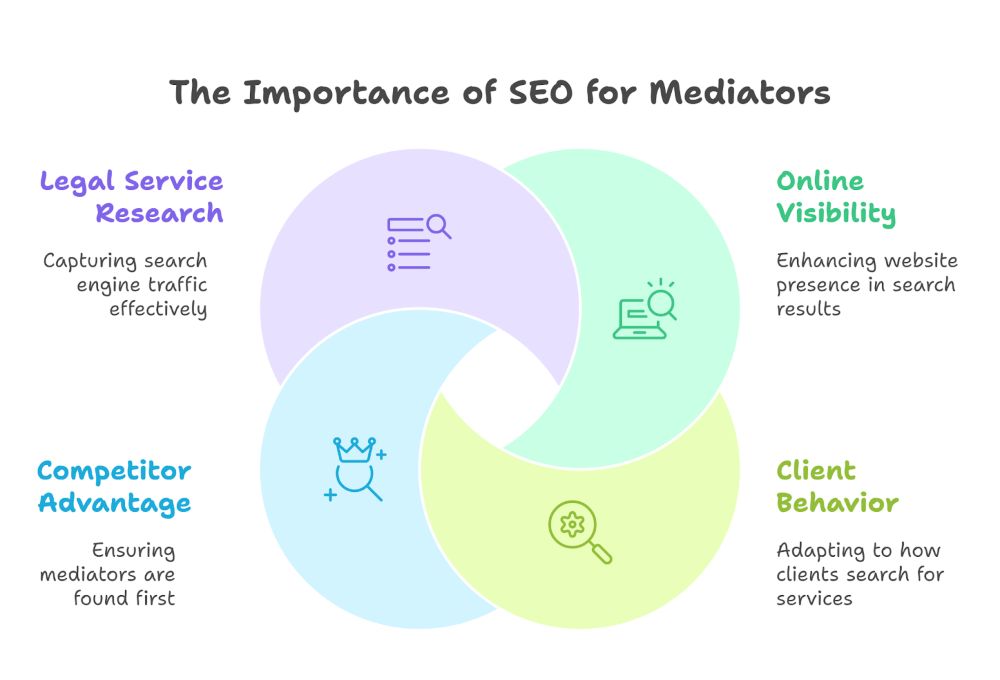
Why SEO is Crucial for Mediator Websites
If your mediation practice isn’t showing up online, it might as well be invisible. When people need help resolving disputes, they turn to Google first.
SEO is your bridge—connecting you with clients at the exact moment they’re searching for guidance.
A well-optimized website ensures that when someone needs a mediator, they find you first—not your competitors.
The Shift Toward Online Search
When people face conflicts that require mediation, they increasingly turn to search engines first. SEO increases a website’s visibility so that potential clients can more readily find mediators.
This fundamental shift in client behavior means mediators must adapt their marketing strategies.
For legal mediators, this trend is particularly significant. Most clients conduct research before making contact, often comparing several options. Without proper SEO, mediator websites remain buried beneath competitors, regardless of the mediator’s expertise or qualifications.
The data shows that 96% of people seeking legal services use a search engine during their research process. Mediators who optimize their websites capture this traffic at the precise moment when clients are actively looking for solutions.
The Power of Credibility in SEO
SEO builds more than just visibility—it establishes authority. SEO shows authority, which is particularly valuable in mediation, where trust is paramount.
High-ranking websites are perceived as more credible by potential clients.
Attorney mediators face unique challenges but can leverage their dual expertise through targeted content strategies. They effectively differentiate themselves by creating resources showcasing legal knowledge and mediation skills.
Good SEO practices improve website structure, loading speed, and navigation. This improves the user experience and enhances perceived professionalism.
Competitive Advantage with SEO
The mediation market is increasingly competitive. SEO is a crucial component of any mediation attorney’s online marketing strategy. Those who invest in optimization gain significant advantages over competitors.
Local SEO is particularly powerful for mediators since most clients seek professionals in their geographic area.
Optimizing for location-specific keywords helps target the right audience. Consider these advantages:
Targeted visibility in specific practice areas (divorce, business, workplace)
Lower client acquisition costs compared to paid advertising
Sustainable traffic that continues without ongoing ad spending
Data-driven insights about potential client needs
Mediation SEO and traditional law firm SEO differ in addressing specific client emotions and situations.
Mediators should emphasize collaborative resolution in their keyword strategy and content rather than adversarial approaches.
Technical SEO – Foundation for High Rankings
Technical SEO creates the foundation for search engines to effectively find, crawl, and index your mediator website.
It’s the backbone that supports all your other SEO efforts and ensures clients can find you when they need mediation services.
Mobile Optimization & Site Speed
Mobile optimization is no longer optional for mediator websites. With over 60% of searches now happening on mobile devices, your site must perform flawlessly across all screen sizes.
Key mobile optimization factors:
Responsive design that adapts to any device
Large, tappable buttons (at least 44×44 pixels)
Easy-to-read fonts (minimum 16px)
Simplified navigation for touchscreens
Site speed directly impacts both rankings and client conversion rates. When potential clients need mediation services, they won’t wait for slow pages to load.
Speed improvement tactics:
Compress all images before uploading
Enable browser caching
Minimize HTTP requests
Use a content delivery network (CDN)
Remove unnecessary plugins and scripts
Test your site speed regularly using Google’s PageSpeed Insights. Aim for a score above 80 on both mobile and desktop.
Secure Website (HTTPS)
HTTPS isn’t just about security—it’s a trust signal that shows potential mediation clients your site is legitimate and professional. Google has confirmed HTTPS as a ranking factor since 2014.
To implement HTTPS properly:
Purchase an SSL certificate (many hosts offer free certificates)
Install the certificate on your server
Set up 301 redirects from HTTP to HTTPS versions
Update internal links to HTTPS
Update your site URL in the Google Search Console
This security layer protects sensitive client information that might be shared through contact forms on your mediator website. This protection is significant for professional service businesses where confidentiality matters.
Implementing Schema Markup for Mediators
Schema Markup helps search engines better understand your mediation services, potentially improving your site’s appearance in search results. For mediators, the right schema can significantly boost local visibility.
Essential schema types for mediators:
LocalBusiness markup
Professional Service markup
Person markup (for mediator profiles)
FAQ markup (for common mediation questions)
Adding schema markup helps Google create rich snippets that stand out in search results.
These enhanced listings can display your mediation specialty, business hours, reviews, and pricing information directly in search results.
Implementation options include JSON-LD (recommended by Google), Microdata, or RDFa. For non-technical mediators, plugins like Yoast SEO can help implement basic schema without coding knowledge.
Local SEO – Attracts Clients in Your Area
Local SEO helps mediators connect with clients in their specific geographic area by improving online visibility in local search results.
Implementing targeted strategies can significantly boost your practice’s visibility when potential clients search for mediation services nearby.
Google Business Profile Optimization
Mediators who want to improve their local visibility must create and optimize a Google Business Profile. This free tool serves as a digital storefront in Google’s ecosystem.
To maximize your GBP effectiveness:
Use the category “Mediator” or “Mediation Service”
Include your complete business name, address, and phone number
Add business hours and services offered
Upload professional photos of your office and team
Create posts about mediation topics regularly (aim for weekly updates)
The profile should feature keywords like “certified mediator,” “family mediation,” or “divorce mediator,” where relevant. Ensure all information matches exactly what appears on your website to avoid confusing search engines and potential clients.
Local Citations & Legal Directories
Local citations build credibility and help search engines verify your business information. These mentions of your practice across the web strengthen your local search presence.
Mediation-specific directories: Mediate.com, ADR Times
Consistency is crucial—ensure your name, address, and phone number (NAP) appear identically across all platforms. This consistency helps search engines recognize your business as legitimate and trustworthy.
Local chambers of commerce and bar association memberships also create valuable citation opportunities that establish local authority in the mediation field.
Leveraging Online Reviews for SEO
Reviews significantly impact both local search visibility and client acquisition. Positive reviews signal to search engines that your mediation service is reputable and relevant.
Effective review strategies include:
Creating a simple process for satisfied clients to leave reviews
Responding professionally to all reviews—both positive and negative
Never purchase fake reviews, as this violates Google’s policies and can result in penalties. Instead, focus on providing excellent service and making the review process convenient for clients.
Google particularly values recent, authentic reviews that mention specific services. Reviews containing keywords like “family mediator” or “business dispute mediation” provide additional SEO value while helping potential clients understand your areas of expertise.
Want your mediation practice to stand out online? 800Commerce specializes in SEO for mediators, helping you rank higher, attract more clients, and grow your business. Get a free consultation today!
Keyword & Content Strategy for Mediators
An effective SEO strategy for mediators requires carefully selected keywords and compelling content that resonates with potential clients seeking mediation services.
This foundation drives qualified traffic to your website and converts visitors into clients.
Finding High-Intent Keywords
Mediators must focus on keywords that indicate a strong intention to hire mediation services. These high-intent keywords help attract qualified leads rather than casual browsers.
Start with location-specific terms like “divorce mediator in [city]” or “family mediation services [location].” These local keywords often have less competition than general terms.
Look for long-tail keywords such as “how to resolve business partnership disputes without litigation” or “peaceful custody mediation process.” These phrases show clear intent and specific needs.
Tools like Google Keyword Planner, Semrush, or Ahrefs can reveal search volume and competition levels. Mediators should also analyze the keywords competing law firms and other mediators target.
High-Value Keyword Categories for Mediators:
Divorce mediation terms
Business dispute resolution
Family conflict mediation
Employment mediation services
Civil case mediation
Creating Content That Converts
Valuable, informative content is crucial for mediator websites. Each piece should address specific client pain points and position the mediator as an authority.
Case studies demonstrating successful mediation outcomes (with anonymized details) build trust with potential clients. These stories should highlight the mediator’s process and expertise.
FAQ pages answering common questions like “How long does mediation take?” or “Is mediation legally binding?” address concerns directly. These pages also naturally incorporate important keywords.
Blog posts should focus on educational topics such as “5 Benefits of Choosing Mediation Over Litigation” or “What to Expect in Your First Mediation Session.” These articles establish expertise while targeting relevant search terms.
Content should always include clear calls to action, encouraging readers to schedule consultations or learn more about services.
Video Content for Engagement
Video content significantly enhances a mediator’s online presence and SEO effectiveness. Search engines favor websites with varied content types, and videos increase the time spent on the site.
Short explainer videos about the mediation process make complex topics accessible. These can address concerns like “What happens during divorce mediation?” or “How mediation saves money compared to litigation.”
Client testimonial videos (with permission) build credibility and trust. Seeing real people discuss positive experiences resonates more deeply than written reviews.
Educational webinars on conflict resolution topics can be repurposed across multiple platforms. The mediator should optimize video titles and descriptions with relevant keywords.
Video transcripts should be included on the website to make content accessible and provide additional SEO benefits. These transcripts give search engines more text to index.
Link Building – Strengthening SEO Authority
Link building is one of the most powerful ways to boost your mediator website’s authority in search engines. When other reputable websites link to yours, Google sees this as a vote of confidence in your content.
Start by getting listed in mediator directories and professional organizations relevant to your specialty.
Guest posting on legal blogs gives you exposure to potential clients while earning valuable backlinks.
Consider contacting law schools, courts, and community organizations that link to your resources.
When competing against lawyer websites, focus on your specialized knowledge. Create comprehensive mediation guides that law firms might reference and link to.
This builds authority through backlinks, which can help mediators outrank general legal websites.
Remember that link building is about quality, not just about accumulating links. One backlink from a respected legal journal carries more weight than dozens from irrelevant sites.
Internal Linking Best Practices
Internal linking creates pathways for both users and search engines to navigate your site effectively. Every mediator service page should link to related content, creating a web of information that keeps visitors engaged.
Use descriptive, keyword-rich anchor text for internal links rather than generic “click here” phrases. For example, link phrases like “divorce mediation process” or “workplace conflict resolution.”
Structure your internal links to create topic clusters around your primary services. For example, a main page about “Family Mediation” might link to specific pages about child custody mediation, divorce mediation, and elder care mediation.
According to SEO experts, search engines view these internal links as signals about your site structure and content relationships.
This helps Google understand your specialty areas, potentially helping you rank higher than general legal sites for mediation-specific searches.
Is your website bringing in the clients you deserve? We optimize your site with 800Commerce’s Local SEO services to dominate search results and increase inquiries. Let’s boost your visibility now!
Measuring SEO Success for Mediators
Tracking the right metrics helps mediators understand if their SEO efforts are working. Effective measurement allows for data-driven decisions that optimize website performance and attract more potential clients.
SEO Performance Metrics
Organic Traffic is perhaps the most important metric for mediator websites. Monitor the number of visitors coming to your site through Google Analytics search engines. A steady increase suggests your SEO strategy is working.
Keyword Rankings show how well your website appears in search results for target terms like “divorce mediator” or “family mediation services.” Track your positions for important keywords that potential clients use to find mediation services.
Conversion Rates measure how many visitors take desired actions on your site:
Completing contact forms
Scheduling consultations
Downloading mediation resources
Calling your office
Bounce Rate indicates how many visitors leave without engaging with your site. High bounce rates might suggest your content isn’t meeting visitor expectations or your site loads too slowly.
Analyzing & Adjusting SEO Strategy
Regular SEO Audits help identify technical issues that may hinder performance. Mediators should review site speed, mobile-friendliness, and broken links quarterly to maintain optimal site health.
Content Performance Analysis reveals which mediation topics resonate with potential clients. Review which pages attract the most traffic and engagement, then create similar content to build on that success.
Competitor Benchmarking provides context for your metrics. Compare your site’s performance against other mediators in your area to identify opportunities for improvement.
When metrics show underperformance, make targeted adjustments rather than overhauling your entire strategy. Small changes to titles, headings, and content often yield significant improvements in rankings and traffic.
Common SEO Mistakes Mediators Should Avoid
Mediators who want effective websites must avoid critical SEO errors that could prevent potential clients from finding their services.
Even small mistakes can significantly impact your visibility in search results and reduce the number of leads your practice receives.
Ignoring Local SEO
Many mediators make the mistake of not optimizing for local search queries. Since mediation services are typically location-based, this oversight can be costly.
Essential local SEO elements include:
Google Business Profile with accurate business information
Local keywords (e.g., “divorce mediator in Chicago”)
Location-specific pages for mediators serving multiple areas
Local business schema markup
Failing to gather positive reviews from satisfied clients also hurts local rankings. Research shows that 87% of potential clients read online reviews before selecting a mediator.
Don’t overlook local directories and legal service listings that can improve your visibility. These citation sources help search engines verify your business information and boost confidence in your legitimacy.
Not Updating Website Content
Static, outdated content is a major SEO mistake for mediators. Search engines favor websites that regularly publish fresh, relevant content.
Content that needs regular updates:
Blog posts addressing common mediation questions
Case studies (with client permission and anonymized)
Changes in mediation laws or procedures
Service offerings and pricing information
Many mediators copy competitors’ content without improvement, which search engines penalize as duplicate content. Instead, create original content that demonstrates your unique expertise and approach.
Content should align with user intent—what potential clients are actually searching for. Focus on addressing common client questions rather than just promoting your services.
Overlooking Website Speed & Security
Legal professionals frequently neglect technical SEO factors like site speed and security. Slow-loading websites frustrate visitors and signal poor quality to search engines.
Speed improvements mediators should implement:
Image optimization (proper sizing and compression)
Minimal use of heavy plugins and scripts
Content Delivery Network (CDN) implementation
Mobile-responsive design
Security is equally important. Lacking an SSL certificate (https://) creates trust issues and can trigger browser warnings that drive away potential clients.
Most mediators underestimate the time required for SEO improvements to show results. Technical fixes may deliver quick wins but expect most SEO efforts to take 3-6 months before significant ranking improvements appear.
Conclusion
Implementing effective SEO strategies can transform a mediator’s online presence. Mediators focusing on technical and content-based optimization position themselves to attract more potential clients.
The most successful mediator websites combine local SEO techniques with quality content that addresses client concerns. This balanced approach helps mediators stand out in a competitive digital landscape.
Building a strong backlink profile remains essential. Mediators who secure quality links from reputable sites can improve their rankings in search results, making them more visible to people seeking mediation services.
Regular website maintenance and content updates signal to search engines that a mediator’s site is relevant and active. This ongoing attention helps maintain and improve search rankings over time.
Mobile optimization cannot be overlooked. Since most searches occur on mobile devices, so mediator websites must function flawlessly across all screen sizes.
Analytics tracking provides valuable insights into website performance. Smart mediators use this data to refine their SEO strategies and better meet potential clients’ needs.
The digital landscape continues to evolve, but the fundamentals of SEO for mediators remain consistent: provide value, establish expertise, and make information accessible. Mediators who commit to these principles will continue to attract clients who need their services.
Don’t let potential clients choose your competitors. 800Commerce’s SEO solutions ensure your mediation services get found by the right people at the right time. Contact us today and take the lead!
Frequently Asked Questions
What is SEO for mediators?
SEO for mediators is the process of optimizing a mediation practice’s website to rank higher on search engines like Google. This includes local SEO, keyword optimization, content marketing, and technical improvements to attract more clients online.
How can mediators improve their Google rankings?
Mediators can improve Google rankings by:
Optimizing Google Business Profile with accurate details and client reviews.
Using relevant keywords like “divorce mediation near me.”
Creating informative blog content to answer common client questions.
Building backlinks from trusted legal directories.
Why is local SEO important for mediators?
Local SEO ensures your mediation services appear when potential clients search for “mediator near me” or similar terms. 46% of all Google searches have local intent, making Google Business Profile, location-based keywords, and local citations essential for ranking higher.
What are the best keywords for mediation SEO?
The best SEO keywords for mediators include:
“Divorce mediation near me”
“Best workplace mediator [city]”
“Family dispute resolution expert”
“Mediation vs. litigation cost comparison” Using long-tail keywords helps attract high-intent clients looking for mediation services.
How do reviews impact SEO for mediators?
Reviews boost local SEO rankings by increasing trust and engagement. 87% of users read online reviews before choosing a service. Encouraging satisfied clients to leave detailed, keyword-rich reviews on Google and legal directories can improve visibility.
What role does content play in mediator SEO?
High-quality content helps mediators rank for more keywords and build credibility. Blogging about common disputes, legal mediation tips, and industry updates attracts visitors and improves search rankings. Websites with consistent content get 55% more traffic than those without.
How long does it take for SEO to show results for mediators?
SEO is a long-term strategy. Most mediators see noticeable ranking improvements in 3-6 months, but consistent content updates, link building, and technical SEO adjustments are necessary for continued growth.
Your best clients are the ones you already have. But how do you keep them engaged, build trust, and encourage referrals?
The answer is email marketing—one of the most effective yet underused tools for mediators.
Here’s the reality: Email marketing has an average return of $36 for every $1 spent (Litmus, 2024). That’s a 3,600% ROI, making it one of the most powerful ways to stay connected with clients.
Mediators who send regular, helpful emails get higher engagement, more referrals, and stronger client relationships.
Unlike social media, where posts disappear in hours, emails stay in inboxes—ready when clients need you.
Many mediators rely solely on referrals, but those who use email marketing gain a competitive advantage.
Your email list becomes a valuable asset allowing you to stay up-to-date with past clients and engage new prospects.
Unlike social media platforms where algorithm changes can limit your reach, email gives you direct access to your audience’s inbox.
Key Takeaways
Email marketing provides mediators with a consistent way to nurture leads and demonstrate expertise beyond traditional referrals.
Building your email list starts with creating valuable lead magnets that address specific client needs.
Personalized, educational content establishes trust and positions you as the expert clients turn to when they need mediation services.
Why Email Marketing Is A Game-Changer For Mediators
Email marketing offers mediators a direct line to potential clients that can transform your practice. It combines personal connection with professional outreach in ways other marketing methods simply can’t match.
The Power Of Staying Top-of-Mind
As a mediator, your services aren’t typically needed daily, but when conflicts arise, you want to be the first name that comes to mind.
Email marketing builds relationships and keeps you visible to potential clients even when they don’t immediately need you.
Regular, valuable communication demonstrates your expertise and reminds clients of your availability.
When you send monthly mediation tips or conflict resolution strategies, you position yourself as a helpful resource rather than just a service provider.
Consider creating a content calendar that includes:
Case study summaries (with confidentiality maintained)
Mediation technique explanations
Updates on relevant laws or regulations
This consistent presence builds trust over time, making prospects more likely to reach out when mediation becomes necessary.
The ROI Of Email Marketing – The Numbers Don’t Lie
Email marketing delivers measurable results and cost-effectiveness that can dramatically improve your practice’s bottom line. The investment is minimal compared to other marketing channels.
For mediators, the ROI advantage is particularly significant:
Average email marketing ROI: $36-$42 for every $1 spent
Client acquisition cost: Lower than paid advertising
Conversion tracking: Easy to measure which messages generate consultations
Your specialized knowledge has substantial value; email allows you to demonstrate this expertise at scale. Analytics tools let you see exactly which topics resonate with your audience.
You can test different subject lines and content types to optimize engagement over time.
This data-driven approach ensures you’re not wasting resources on ineffective outreach.
Why Mediators Need Email More Than Social Media
While social platforms have their place, email provides direct, personalized communication that’s especially critical for mediation services. Your messages arrive in private inboxes rather than competing in crowded social feeds.
Email communication respects the confidential nature of mediation work. You can discuss sensitive topics professionally without public exposure on social media.
Your prospects maintain control over how and when they engage with your content. This respectful approach aligns perfectly with mediation principles.
Email also allows you to segment your list based on:
Types of disputes (family, business, workplace)
Previous engagement with your services
Specific interests or concerns
This targeted approach means you can nurture leads with relevant information that addresses their specific mediation needs, creating a more meaningful connection.
Building A High-Quality Email List – Strategies That Work
Growing your email list requires specific strategies that attract potential mediation clients.
Focus on creating valuable content, optimizing your website, and leveraging in-person opportunities to collect contact information ethically.
Creating Lead Magnets That Attract The Right Clients
Lead magnets are essential tools for mediators looking to build their email lists.
Create resources that address specific pain points your potential clients face.
Offer something free in exchange for emails, such as:
Conflict resolution guide: A PDF showing basic mediation techniques people can use in everyday situations
Mediation preparation checklist: Help clients understand what to expect
Mini-course: A 3-day email series explaining the benefits of mediation over litigation
Make sure your lead magnets demonstrate your expertise while providing genuine value. Your goal is to attract qualified leads who actually need mediation services.
Track which lead magnets perform best and refine your offerings based on download rates and client conversion metrics.
Optimizing Your Website For More Sign-Ups
Your website is your most powerful tool for email collection. Add sign-up forms to high-traffic pages, such as your homepage and blog posts.
Strategic placement options include:
Exit-intent popups: Capture visitors before they leave your site
Footer sign-up forms: Non-intrusive but always visible
Blog post embeds: Place forms within content about mediation topics
Make your sign-up process simple with minimal fields—name and email are often sufficient.
Clearly communicate the benefit of joining your list, such as “Receive conflict resolution tips every Tuesday.”
Test different form designs and messaging to determine what resonates with your audience. To build trust, consider adding testimonials near your sign-up forms.
Using Networking & Events To Collect Emails
In-person events provide excellent opportunities to build your email list with qualified leads.
When attending legal conferences, business networking events, or community workshops:
Bring a tablet with a simple sign-up form or physical signup sheets
Offer to share your presentation slides or additional resources via email
Host a workshop where attendees register with their email
Follow up promptly after events with a personalized welcome email reinforcing how you met.
This grounds your brand with social proof and establishes a connection.
Consider partnering with complementary professionals like attorneys or financial advisors for co-hosted webinars. This exposes you to their audience while positioning you as an expert in conflict resolution.
Remember always to follow email marketing regulations when adding new contacts to your list.
Creating Emails That Clients Actually Open and Read
Your email marketing success depends largely on crafting messages that get opened, read, and acted upon.
The right approach can dramatically increase your engagement rates and help establish your mediation practice as trustworthy and valuable.
Writing Subject Lines That Get Clicked
Subject lines are your first—and sometimes only—opportunity to capture attention. For mediators, specific subject lines that highlight value work best. Personalized subject lines increase open rates by 26% (Campaign Monitor, 2023).
Keep subject lines under 50 characters to ensure they display fully on mobile devices.
Avoid spam triggers like “FREE” or excessive punctuation that can send your carefully crafted emails straight to the junk folder.
Try these proven approaches:
Question format: “Need help resolving your business partnership dispute?”
Specific benefits: “5 Ways Mediation Saves You Money in Divorce Proceedings”
Urgency (when appropriate): “Last chance to schedule March mediation sessions”
Personalized subject lines that include the recipient’s name can increase open rates by up to 26%. Test different approaches to see what resonates with your specific client base.
The Ideal Email Structure For Mediators
Structure your emails to be scannable and action-oriented. Most people skim emails before deciding to read them fully.
Start with a brief, personal greeting using the client’s name. Follow with a single paragraph that establishes relevance to their situation.
The body should follow this pattern:
Problem identification – Acknowledge the challenge they’re facing
Value proposition – How mediation addresses this specific challenge
Credibility elements – Brief mention of your experience or success with similar cases
Clear call-to-action – One specific next step you want them to take
Break up text with bullets or numbered lists to make it easier to read. Also, include white space between paragraphs to avoid overwhelming readers with dense text.
Strategic personalization based on client information you’ve gathered helps demonstrate that you understand their unique situation.
Best Days & Times To Send Emails For Maximum Engagement
Timing can significantly impact whether your mediation emails get opened. Data shows that Tuesday, Wednesday, and Thursday generally yield the highest open rates for professional services.
Mid-morning (around 10 AM) and mid-afternoon (2-3 PM) are optimal sending times when people check email during work breaks.
Avoid Mondays when inboxes are typically full and Fridays when people are winding down their week.
Consider your specific client demographics:
Corporate clients: Business hours, Tuesday-Thursday
Individual clients: Early evening hours or weekend mornings
Legal professionals: Early morning (8-9 AM) before court sessions
Use your email marketing analytics to track when your particular audience is most responsive.
Most email platforms provide reports showing which emails performed best and at what times, allowing you to refine your sending schedule accordingly.
Want to attract more clients and keep them engaged? 800Commerce helps mediators craft powerful email marketing campaigns that build trust, boost referrals, and increase retention. Start your strategy today!
Nurturing Client Relationships With Smart Email Sequences
Email sequences help you stay connected with potential mediation clients through their decision-making journey. These automated messages deliver value quickly, building trust and positioning you as their go-to mediator.
Welcome Emails – The First Step In Building Trust
Your welcome email sets the tone for your entire relationship. Make it count by:
Thanking clients for subscribing to your list
Introducing yourself and your mediation approach
Explaining what they can expect from your emails
Include a small but valuable offer (like a free consultation)
The best welcome emails are warm, professional, and action-oriented. Lead nurturing emails that start strong can significantly improve your conversion rates.
Don’t overwhelm new subscribers. A simple, clean email that addresses their mediation concerns works better than a complex message with too many options.
Consider creating a 3-part welcome sequence that gradually introduces your services, shares a client success story, and invites them to book a call.
Educational Sequences – Becoming Their Go-To Resource
Position yourself as a valuable resource by creating email nurture sequences that educate potential clients about mediation. These emails should:
Address common concerns people have about the mediation process
Highlight the benefits of mediation over litigation
Share tips for preparing for a successful mediation
Feature case studies (with confidentiality maintained)
Educational emails work best when they solve specific problems.
For example, send an email explaining “5 Ways to Prepare for Your First Mediation Session” rather than general information.
To appeal to different learning styles, use a mix of formats—short articles, checklists, and video explanations.
Always include a clear call to action, whether it’s booking a consultation or downloading a resource.
Re-Engagement Emails – Bringing Clients Back
Not every prospect converts immediately. Re-engagement email sequences help you reconnect with dormant contacts who haven’t responded to your previous outreach.
These emails should:
Acknowledge their inactivity without being pushy
Provide fresh value or a new perspective on mediation
Include a compelling offer (discount, special session format)
Use subject lines that spark curiosity or address pain points
Try sending a “checking in” email that asks directly about their current situation.
This personal touch often gets better responses than promotional messages.
Track which re-engagement emails perform best and refine your approach accordingly.
Sometimes, a simple “Is mediation still on your radar?” message works better than complicated content.
The Secret To Higher Engagement – Email Personalization & Automation
Email marketing success for mediators hinges on creating messages that resonate personally with potential clients.
Personalization and automation create a powerful system that saves you time and significantly increases client engagement.
Why Generic Emails Don’t Work Anymore
Today’s clients expect communications explicitly tailored to their situation.
Generic “Dear Client” emails with one-size-fits-all content typically perform poorly, with lower open rates and minimal engagement.
Your mediation clients face unique challenges that require personalized attention.
Consider these stark differences in performance:
Generic emails: 15-20% open rates
Personalized emails: 40-60% open rates
When you address clients by name and reference their specific dispute type, you demonstrate understanding and create an immediate connection.
This personal touch shows that you recognize their unique situation.
Segment your email list by dispute type, client history, or referral source to make content immediately relevant.
Remember that clients are more likely to engage with content that speaks directly to their specific mediation needs.
Automating Emails To Save Time and Increase Conversions
As a mediator, your time is valuable. Email automation allows you to maintain consistent client communication while focusing on your core mediation work.
Start with a welcome email series that introduces new clients to your mediation process.
Set up trigger-based emails that:
Send process explanations after initial consultations
Provide preparation materials before the scheduled mediation
Request feedback after the case conclusion
Automation tools like MailChimp or ConvertKit make this process straightforward.
You can create “set and forget” sequences that nurture leads through your entire mediation process.
By segmenting based on engagement levels, you can automatically send follow-up content to less engaged prospects while moving active leads to your scheduling system.
How To Use AI To Improve Email Personalization
AI tools have revolutionized email personalization for mediators. These technologies analyze client data to create highly targeted content that resonates with specific mediation needs.
You can implement AI in several practical ways:
Subject Line Optimization: AI can help craft attention-grabbing subject lines that dramatically improve open rates. Test different approaches with your audience to find what works best.
Content Recommendations: Use AI to suggest relevant mediation articles, case studies, or resources based on a client’s dispute type or industry.
Behavioral Triggers: Set up systems that automatically recognize when clients open emails or click links, then send appropriate follow-up content.
The key is using AI to enhance—not replace—your personal touch.
The most effective mediation emails combine technological efficiency with your unique expertise and empathetic approach.
Is your email list just sitting there? Let 800Commerce’s automated email solutions turn it into a client-generating machine! From newsletters to lead nurturing, we make email marketing effortless. Let’s optimize your outreach now!
Tracking Email Success – Key Metrics Every Mediator Should Watch
Understanding how your emails perform helps you refine your outreach strategy and connect more effectively with potential clients.
The right metrics reveal what content resonates with your audience and where improvements can make the biggest impact.
Measuring Open & Click-Through Rates
Open rates tell you how many recipients actually open your emails.
For mediators, healthy open rates typically range from 15-25%, depending on your list quality.
When your rates drop, consider testing different subject lines that address specific mediation pain points.
Click-through rates (CTRs) measure the number of people who click on links within your email. This metric reveals whether your content motivates action.
Aim for CTRs of 2-5% for industry standards.
Tips to improve these metrics:
Use personalized subject lines that mention mediation specialties
Keep subject lines under 50 characters
Place your most important link “above the fold” so readers see it without scrolling
Use clear, benefit-focused call-to-action buttons (“Schedule Your Consultation”)
Track these metrics over time to identify trends in what topics most interest your potential clients.
Understanding Email Bounce & Unsubscribe Rates
Bounce rates indicate how many emails never reached their destination.
Hard bounces (permanent delivery failures) should be removed from your list immediately. Soft bounces (temporary issues) should be monitored but may resolve themselves.
A healthy bounce rate stays below 2%, and higher rates signal list quality problems or potential sending reputation issues.
Unsubscribe rates measure how many recipients opt-out after receiving your email.
While losing subscribers can be disappointing, this metric helps you refine your list to those truly interested in mediation services.
What’s normal? Unsubscribe rates under 0.5% per email campaign indicate your content aligns with subscriber expectations.
Spikes often follow:
Dramatic changes in email frequency
Content that doesn’t match why they subscribed
Overly promotional messages without value
Clean lists with engaged subscribers generate better results than larger lists with uninterested recipients.
A/B Testing – What Works Best For Your Audience
A/B testing compares two versions of your email to see which performs better.
As a mediator, this data-driven approach helps you optimize your campaigns based on what works for your audience.
Elements worth testing include:
Subject lines (question vs. statement, length, personalization)
Send times (morning vs. afternoon, weekday vs. weekend)
Content format (case studies vs. tips, long vs. short)
Call-to-action placement and wording
Start with one variable at a time to identify what caused performance changes.
Most email platforms offer built-in A/B testing features that automatically send the winning version to the rest of your list.
Common Email Marketing Mistakes Mediators Must Avoid
Email marketing can significantly boost your mediation practice, but certain pitfalls can undermine your efforts. Avoiding these common mistakes will help you maintain a strong sender reputation and develop meaningful connections with potential clients.
Sending Too Many Or Too Few Emails
Finding the right email frequency is crucial for mediators. Bombarding clients with daily messages can quickly lead to unsubscribes and damage your reputation. Your contacts will feel overwhelmed and may mark your emails as spam.
Conversely, emailing too infrequently (like once every few months) may cause clients to forget who you are or why they signed up. This disconnect makes them less likely to engage with your services when needed.
A balanced approach works best for mediation services. Consider sending:
Monthly newsletters with valuable conflict resolution tips
Quarterly updates about your practice
Occasional emails about special workshops or events
Track your open and click rates to determine your optimal frequency. Also, make sure you don’t ignore the sender’s reputation, which can land your carefully crafted messages in spam folders.
Not Having A Clear CTA
Every email you send should have a distinct purpose and a clear call to action (CTA). Without this direction, recipients may read your email but not take meaningful steps to use your mediation services.
Your CTA should be:
Visible – Use contrasting colors for buttons
Direct – State exactly what you want the reader to do
Singular – Focus on one main action per email
For mediators, effective CTAs might include “Schedule a Consultation,” “Download Our Conflict Resolution Guide,” or “Register for Our Workshop.” Make these actions simple to complete with just one or two clicks.
The weak offers mentioned in common marketing mistakes also apply to mediators. Ensure your CTA provides value to potential clients who are dealing with conflict.
Ignoring Mobile Optimization
Most clients will read emails on mobile devices, making optimization essential. Emails that display poorly on phones create a frustrating experience and reflect poorly on your professional standards as a mediator.
To ensure mobile-friendly emails:
Use responsive email templates
Keep subject lines under 40 characters
Write concise paragraphs (1-3 sentences)
Make buttons large enough to tap easily
Test your emails on different devices before sending them. Images should load quickly, and text should be readable without zooming.
Emails that are not mobile-optimized are one of the most common mistakes that can hurt your conversion rates.
When potential clients can’t easily navigate your email on their phone, they’re unlikely to take the next step in engaging your mediation services.
Action Plan – Get Started With Email Marketing Today
Email marketing offers mediators a powerful way to nurture relationships with potential clients and stay connected with past ones. Getting started doesn’t have to be complicated or time-consuming.
The 5-Step Quick Start Guide For Mediators
Build your email list – Start collecting email addresses from your website visitors, networking events, and current clients. Add a simple sign-up form to your website offering a valuable resource like a “Conflict Resolution Guide” in exchange for email addresses.
Choose an email platform – Select an email marketing service that fits your needs. Options like MailChimp, Constant Contact, or ConvertKit offer user-friendly interfaces that are perfect for beginners.
Create valuable content – Develop emails that help your audience. Share mediation tips, client success stories, or industry updates. Focus on providing valuable content rather than being overly promotional.
Craft compelling subject lines – Your emails won’t work without opening them. Use attention-grabbing subject lines that promise clear value to recipients.
Analyze and improve – Review open rates and click-through metrics to understand what resonates with your audience. Then, adjust your approach based on these insights.
Need Help? Let 800Commerce Handle It For You.
Not every mediator has the time or expertise to manage their email marketing campaigns. 800Commerce specializes in helping mediation practices build effective email marketing systems without the hassle.
Our team can help you develop a customized email strategy that reflects your unique practice. We handle everything from list building to content creation and campaign analysis.
Starting your email marketing doesn’t have to be overwhelming. With our beginner-friendly approach, you’ll reach potential clients effectively while maintaining your focus on mediation work.
Email marketing offers mediators a powerful way to build and maintain client relationships. By creating valuable content that addresses your audience’s needs, you can establish yourself as a trusted expert in conflict resolution.
Remember that consistency is key. Regular communication through welcome emails and drip campaigns helps move potential clients down your sales funnel while providing ongoing value.
Personalization makes a significant difference in your email effectiveness. Learn about your audience over time and adjust your approach based on their responses and engagement.
These valuable resources can attract new subscribers who are genuinely interested in your services.
Measure your results consistently through open rates, click-throughs, and conversions. This data helps you refine your approach and improve future communications.
Implementing these email marketing strategies helps you build a robust client list. This list generates new business and strengthens your existing client relationships.
Your mediation practice deserves a smarter way to connect with clients. 800Commerce specializes in email marketing, automation, and audience engagement tailored for mediators. Contact us today and start growing your client list!
Frequently Asked Questions
What is email marketing for mediators?
Email marketing is a strategic way for mediators to connect with past, current, and potential clients through email campaigns. It helps mediators build relationships, provide legal insights, and generate referrals while keeping their services top-of-mind.
Why is email marketing important for mediators?
Email marketing helps mediators increase client retention, gain referrals, and establish credibility. Studies show that email marketing generates an average ROI of 3,600% (Litmus, 2023), making it one of the most cost-effective marketing tools.
How can mediators build an email list?
Mediators can grow their email list by:
Adding sign-up forms to their website
Offering free resources like e-books or legal guides
Collecting emails at networking events and workshops
Using social media promotions to encourage sign-ups
What types of emails should mediators send?
Effective email campaigns for mediators include:
Newsletters: Legal updates and mediation insights
Educational Emails: Conflict resolution tips
Event Invitations: Webinars, workshops, and networking events
Client Follow-ups: Case updates and check-ins
How often should mediators send emails?
Mediators should send one to two emails per month to maintain engagement without overwhelming subscribers. The best days for email open rates are Tuesdays and Thursdays (Mailchimp, 2023).
How can mediators improve email open rates?
To increase open rates, mediators should:
Use personalized subject lines (e.g., “John, Let’s Talk About Mediation Options”)
Keep emails short and to the point
Send at the best times (morning or early afternoon)
Segment their audience for targeted messaging
What are the best email marketing tools for mediators?
Popular email marketing platforms for mediators include:
Mailchimp – User-friendly automation and analytics
Constant Contact – Great for client follow-ups and engagement
ActiveCampaign – Advanced automation and segmentation
ConvertKit – Best for educational content and newsletters
Marketing a mediation practice requires more than just having excellent conflict resolution skills.
A successful mediation business needs a clear marketing strategy that focuses on client needs, builds trust, and demonstrates expertise in dispute resolution.
Marketing is essential for establishing and maintaining a productive mediation business. Mediators must recognize that potential clients seek solutions to their problems, not just a list of services.
The most effective marketing approaches center on addressing client needs rather than promoting qualifications.
This client-focused approach helps mediators connect with their target audience and showcase their value in dispute resolution.
Professional mediators can stand out in this growing field by combining traditional networking with digital marketing tactics.
A strong online presence, relationship building, and targeted outreach create multiple pathways for clients to discover and choose mediation services.
Key Takeaways
A strategic marketing plan focused on client needs builds a stronger mediation practice.
Online presence and professional networking create multiple channels for client acquisition.
Clear communication of dispute resolution benefits attracts more potential clients.
Why Marketing Is Crucial for Mediators
Marketing plays a vital role in building a successful mediation practice. A strong marketing strategy helps mediators connect with people and organizations who need dispute resolution services.
Many skilled mediators struggle to find clients simply because potential customers don’t know about their services. Even experienced professionals need to actively promote their conflict resolution expertise.
Competition in alternative dispute resolution continues to grow. To stand out in the marketplace, mediators must differentiate themselves and highlight their unique abilities.
Most people only seek mediation services when facing conflicts or disputes. This means mediators need ongoing marketing efforts to remain visible and top-of-mind when potential clients require help.
Building relationships with the legal community and getting listed on court mediation panels creates valuable referral networks. These connections often lead to steady work opportunities.
A mediator’s skill in conflict resolution holds little value if clients can’t find them. Effective marketing allows mediators to showcase their value and build trust with potential clients before the first meeting.
How Effective Marketing Drives More Clients
Effective marketing creates a steady flow of new clients and builds a strong mediation practice. It also allows mediators to showcase their skills and reach the right people who need their services.
A clear marketing strategy helps mediators stand out in a competitive field. Marketing plans work best when they match the mediator’s personal style and strengths.
Mediators need to identify their target audience, which may include lawyers, businesses, couples, or community organizations that might need mediation services.
Smart business development includes having a professional website, being active on LinkedIn, and joining mediation associations. These tactics help build credibility and visibility.
Strong marketing materials should focus on:
Experience and qualifications
Types of disputes handled
Success stories
Professional certifications
Service areas
Professional appearance matters. Mediators should dress professionally and prepare a clear 30-second introduction about their services.
Marketing efforts need to be reviewed and updated regularly. This helps mediators track what works and adjust their approach to attract more clients.
1. Build a Professional Website (With SEO & Lead Capture Features)
A professional website acts as a digital storefront for mediators to showcase their expertise and connect with potential clients.
Strong web design, search optimization, and lead generation features create a steady flow of qualified prospects.
Essential Elements of a Mediator’s Website
The homepage must clearly state the mediator’s value proposition and areas of specialization. Include professional headshots and a brief bio highlighting relevant experience and certifications.
Create dedicated service pages for each type of mediation offered, with detailed descriptions and pricing information.
Add a blog section to demonstrate expertise through helpful content about conflict resolution strategies.
Essential pages to include:
About page
Services and fees
Contact information
Client testimonials
FAQ section
Resources for clients
SEO Strategies to Rank Higher on Google
Focus on local SEO by including city and state in page titles, meta descriptions, and content. Effective marketing strategies should target geographic-specific keywords.
Create content around common mediation-related search terms:
Family mediation process
Business dispute resolution
Workplace conflict mediation
Divorce mediation cost
Use schema markup to help search engines understand the website’s content and purpose.
Lead Capture Features to Convert Visitors into Clients
Place clear calls-to-action (CTAs) on every page offering free consultations or downloadable resources.
Install live chat software to engage visitors immediately. This helps answer questions and build trust.
Create valuable lead magnets like:
Mediation preparation checklists
Conflict resolution guides
Case study PDFs
Mediation process roadmaps
Add contact forms strategically throughout the site, keeping them short and simple to increase completion rates.
2. Optimize Your Google Business Profile for Local Search
Local visibility on Google directly impacts how many potential clients find and contact a mediation practice.
How to Set Up & Verify Your Google Business Profile
Start by claiming the business listing at business.google.com. Fill in every field with accurate information:
Business name exactly as it appears on signage and legal documents
Complete address and service area
Phone number and website URL
Business category (select “Mediation Service” as primary)
Business hours and appointment availability
The verification process typically takes 1-2 weeks. Google sends a postcard with a verification code to the business address. Enter this code promptly to unlock full profile management capabilities.
Add high-quality photos of the mediation office and team
Write a detailed business description using relevant keywords
List all mediation services offered
Post weekly updates about mediation tips or business news
Include attributes like “wheelchair accessible” or “virtual appointments available.”
Keep contact information and hours current. Respond to messages within 24 hours to maintain the “responsive to customers” badge.
Encouraging & Managing Client Reviews
Reviews influence local search rankings and client decisions. Create a simple review request process:
Send follow-up emails after successful mediation
Include direct review links in communications
Thank reviewers within one business day
Address negative reviews professionally and constructively
Never offer incentives for reviews, as this violates Google’s policies. Focus on providing excellent service that naturally encourages positive feedback.
Want more clients for your mediation business? 800Commerce offers SEO-driven marketing solutions that make your services stand out. Get noticed, get leads, and grow your practice—start your marketing transformation today!
3. Use Content Marketing to Establish Authority
Content marketing helps mediators showcase their expertise and build trust with potential clients through valuable educational resources.
Strategic content creation positions mediators as industry leaders while addressing real client needs.
Writing Blog Posts That Address Common Client Concerns
Content marketing plays a central role in generating and converting mediation leads. Blog posts should focus on common mediation questions and challenges that clients face.
Effective blog topics include:
Steps in the mediation process
Tips for preparing for mediation
Cost comparisons between mediation and litigation
Common misconceptions about mediation
Each post needs clear, actionable advice that demonstrates deep expertise. Posts should be easy to read and include relevant examples.
The Power of Video Content in Mediation Marketing
Video content helps mediators connect with potential clients on a personal level. Short video clips allow clients to see the mediator’s communication style and professionalism firsthand.
Key video content ideas:
Brief explanations of mediation concepts
Virtual office tours
Client success story highlights
Tips for dispute resolution
Videos should be 2-3 minutes long and focus on one specific topic. Professional lighting and clear audio are essential for maintaining credibility.
Case Studies & Testimonials: Building Credibility Through Real Stories
Marketing success requires strong proof of a mediator’s ability to facilitate solutions. Case studies demonstrate real outcomes while protecting client confidentiality.
Elements of effective case studies:
Initial conflict situation
Key challenges faced
Mediation approach used
Resolution achieved
Time and cost savings
Client testimonials add authenticity when they highlight specific benefits like improved communication or preserved relationships.
4. Network with Lawyers & Business Professionals for Referrals
Building strong professional relationships leads to a steady flow of client referrals for mediation services.
A strategic mix of networking activities and valuable connections with attorneys and business leaders creates multiple pathways for new business development.
How to Connect with Law Firms for Referral Partnerships
Lawyer referral marketing requires a targeted approach. Mediators should identify law firms that handle cases suited for mediation, like family law or commercial disputes.
Schedule coffee meetings with attorneys to learn about their practice areas and client needs. Share how mediation services can benefit their clients and complement their legal work.
Create a simple referral tracking system to monitor which partnerships generate the most business. Send thank-you notes and updates about successful mediation outcomes to referring attorneys.
Engaging with Local Business Associations & Networking Groups
Join and actively participate in the local chamber of commerce and industry-specific business groups. Take leadership roles in committees to increase visibility.
Professional networking works best when focused on building genuine relationships rather than just collecting business cards. Attend regular meetings and follow up with meaningful one-on-one conversations.
Consider joining specialized groups like:
Business networking organizations
Professional women’s associations
Industry-specific meetups
Local bar associations
Hosting Workshops & Webinars to Expand Your Reach
Organize educational events that showcase mediation expertise while providing value to potential referral partners. For example, host lunch-and-learn sessions at law firms about effective conflict resolution.
Create webinars on specific mediation topics like:
Business partnership disputes
Employment conflict resolution
Family business succession planning
Record and share workshop content through professional social media channels to reach wider audiences. Provide attendees with practical tools and resources they can use in their own practices.
5. Leverage Social Media (LinkedIn, Facebook, YouTube)
Social media marketing creates valuable connections with potential mediation clients and helps establish professional credibility. A strong online presence across key platforms allows mediators to showcase expertise and reach different audiences.
LinkedIn: Building a Professional Presence & Authority
LinkedIn serves as the primary platform for mediators to connect with legal professionals and corporate clients. Creating detailed posts about conflict resolution techniques and sharing case studies demonstrates expertise.
Mediators should post 2-3 times per week with content focused on:
Professional certifications and continuing education
Thought leadership articles
Regular engagement with other professionals’ content helps build visibility. Commenting thoughtfully on posts from lawyers, HR managers, and business leaders creates meaningful connections.
Facebook: Engaging with Local Communities & Client Outreach
Facebook helps mediators connect with local businesses and community members seeking dispute resolution services. Regular activity on social media builds trust and awareness.
Creating a business page enables mediators to:
Share client testimonials and success stories
Post about local events and workshops
Offer mediation tips and conflict resolution advice
Highlight community involvement
Joining and participating in local business groups expands reach to potential clients who need mediation services.
YouTube: Educating Potential Clients Through Video
Video content helps explain complex mediation concepts in an accessible format. Short educational videos build credibility and attract clients seeking information about the mediation process.
Key video topics should include:
Basic mediation principles and benefits
Common dispute scenarios and solutions
Client preparation guidelines
Frequently asked questions
Professional video quality matters, but the content value is the most important. Videos should be 3-5 minutes long and include clear calls to action.
A strong online presence is the key to client trust. 800Commerce specializes in website design and optimization to help mediators attract and convert more leads. Elevate your business—let’s build your digital success today!
6. Invest in Targeted Online Advertising
Digital advertising puts your mediation services in front of the right people at the right time. A well-planned ad strategy reaches potential clients when they need help with conflict resolution.
Google Ads vs. Social Media Ads: Choosing the Right Platform
Google Ads excels at reaching people who are actively searching for mediation services. These ads appear when someone searches terms like “divorce mediator” or “business dispute resolution.” The targeting focuses on client needs, not service descriptions.
LinkedIn offers precise professional targeting for B2B mediation services. Its platform allows mediators to target specific industries, job titles, and company sizes.
Facebook and Instagram work better for family mediation and personal dispute services. These platforms offer detailed demographic and interest-based targeting options.
Retargeting Ads to Re-Engage Potential Clients
Retargeting shows ads to people who visited your website but didn’t contact you. These ads keep your mediation practice visible as potential clients research their options.
A basic retargeting strategy includes:
Website visitor tracking
Custom ad content for different visitor types
Multiple touchpoints across various platforms
Ads should target different stages of the decision-making process. Early-stage ads focus on education, while later-stage ads emphasize booking consultations.
Budgeting & Measuring ROI for Ad Campaigns
Start with a small daily budget of $20-50 to test different ad approaches. Track key metrics:
Cost per click (CPC)
Conversion rate
Cost per client acquisition
Return on ad spend (ROAS)
Professional mediators succeed by measuring results and adjusting campaigns based on data. Monitor which keywords and platforms bring quality leads.
Set clear conversion goals, such as consultation bookings or contact form submissions. This will help calculate the cost of acquiring new mediation clients through ads.
7. Run Email Campaigns for Client Retention
Email campaigns help mediation businesses stay connected with clients while generating repeat business and referrals. Regular communication builds trust and positions mediators as industry experts.
Building an Email List of Prospective & Past Clients
After each mediation session or consultation, create a marketing directory with client contact information, including names, phone numbers, and email addresses.
Ask satisfied clients for referrals and permission to add their contacts to the email list. This expands reach through trusted connections.
Set up email signup forms on the business website and social media profiles. Offer valuable content like mediation guides or conflict resolution tips in exchange for email addresses.
Types of Emails That Drive Engagement
Send monthly newsletters featuring mediation success stories, industry updates, and practical conflict resolution advice. This demonstrates expertise and value.
Create educational content about different types of mediation services. Include real case studies that showcase positive outcomes.
Use targeted messaging for specific client segments. Send customized content to corporate clients, family mediation clients, or those interested in specific dispute types.
Best Practices for Personalization & Automation
Use email marketing tools to segment contacts based on their mediation interests and history. This ensures relevant content delivery.
Set up automated welcome emails for new subscribers and follow-up messages after mediation sessions. Include personalized recommendations and resources.
Track open rates, click-through rates, and engagement metrics. Use these insights to refine email content and timing for better results.
Keep emails brief and focused on one main topic. Use clear subject lines and calls to action that encourage responses or bookings.
Don’t let potential clients pass you by. 800Commerce delivers targeted digital marketing to position your mediation services in front of the right audience. Take action now to boost your visibility and grow your client base!
Frequently Asked Questions
How do I market my mediation business effectively?
Build a professional website, optimize your Google Business Profile, and use content marketing to attract clients. Network with lawyers and business professionals, leverage social media, invest in targeted ads, and run email campaigns to retain clients.
Why is marketing important for mediators?
Marketing helps mediators attract clients, build credibility, and stay competitive. Since most clients seek mediation only when conflicts arise, consistent marketing ensures visibility when they need help.
What should a mediator’s website include?
A mediation website should have a clear value proposition, service pages, client testimonials, a blog, and contact options. SEO optimization and lead capture tools help convert visitors into clients.
How can mediators attract clients through networking?
Mediators can gain clients by networking with lawyers, business professionals, and local organizations. Attending events, joining associations, and forming referral partnerships increase visibility and trust.
How does social media help mediation businesses grow?
Social media increases visibility and client engagement. LinkedIn builds professional credibility, Facebook fosters community interaction, and YouTube videos educate potential clients about mediation services.
What online advertising strategies work best for mediators?
Google Ads targets clients searching for mediation, while LinkedIn reaches professionals needing dispute resolution. Facebook and Instagram work well for family mediation. Retargeting ads help convert interested visitors.
How can mediators use email marketing to retain clients?
Email marketing keeps mediators connected with clients through newsletters, mediation tips, and success stories. Automated follow-ups encourage bookings and referrals.
Social media marketing gives mediators a powerful way to connect with potential clients and showcase expertise.
A strong social media strategy helps mediators build trust, increase visibility, and generate quality leads through platforms like LinkedIn and Facebook.
Marketing your mediation practice requires a mix of relationship-building and professional branding. Social media allows you to demonstrate your conflict resolution skills, share success stories, and engage with other professionals who can refer clients to you.
Building an effective social media presence starts with choosing the right platforms and creating valuable content that addresses your target audience’s needs. You should focus on establishing yourself as a trusted expert while maintaining professional boundaries.
Key Takeaways
Strategic social media marketing helps mediators attract clients and build professional credibility.
Regular engagement on LinkedIn and Facebook creates valuable referral relationships.
Consistent, educational content demonstrates your expertise and builds trust with potential clients.
Best Social Media Platforms For Mediators
Different social media platforms attract distinct professional audiences and offer unique ways to showcase mediation expertise. Each platform requires specific content strategies to reach potential clients effectively.
Choosing The Right Platform Based On Your Audience
LinkedIn is the top choice for professional mediators targeting business clients. Your target audience of lawyers, executives, and HR professionals spend significant time here.
Facebook works well for mediators focusing on family or community mediation. The platform’s demographics skew towards adults aged 25-54 who often need divorce or workplace mediation services.
Instagram appeals to younger professionals and millennials. Use this platform if your mediation practice targets startups or Generation Z entrepreneurs.
Create detailed audience personas to match platforms with your ideal clients:
Business Mediators: Focus on LinkedIn
Family Mediators: Prioritize Facebook
Workplace Mediators: Combine LinkedIn and Twitter
Key Differences Between Social Media Platforms
Each platform requires unique content approaches:
Platform
Content-Type
LinkedIn
– Long-form professional articles
– Industry insights
– Case studies (anonymized)
Facebook
– Short educational posts
– Client testimonials
– Live Q&A sessions
Twitter
– Quick mediation tips
– Industry news
– Professional networking
LinkedIn Marketing: How To Build Authority & Get Clients
LinkedIn stands out as the top platform for professional service providers to showcase expertise and connect with potential clients.
A strong LinkedIn presence helps mediators establish credibility and generate high-quality leads through strategic content and networking.
Optimizing Your LinkedIn Profile For Professional Branding
Your LinkedIn profile serves as your digital business card. Make it count by adding a professional headshot and creating a compelling headline with “Mediator” and your key specialties.
Write a detailed “About” section highlighting your mediation experience, certifications, and successful case outcomes. Use specific numbers when possible.
Add your mediation services to the “Featured” section with clear descriptions of what you offer. Include any relevant professional certifications and achievements to build trust.
Use industry-relevant keywords throughout your profile to improve visibility when potential clients search for mediators.
Creating And Sharing Thought Leadership Content
Create valuable content that demonstrates your expertise in mediation. Focus on:
Case studies (anonymized)
Mediation tips and best practices
Industry trends and insights
Common conflict resolution scenarios
Post consistently, aiming for 2-3 times per week. Mix content formats between text posts, articles, and short videos.
Engage with comments on your posts to build relationships and show you’re actively involved in discussions.
Networking And Connecting With Industry Professionals
Send personalized connection requests to:
Other mediators
Legal professionals
HR managers
Business consultants
Potential clients in your target market
Join and participate in mediation-focused LinkedIn groups. Share your expertise by answering questions and contributing to discussions.
Build meaningful relationships by commenting on others’ posts and sharing their relevant content with your network.
Direct message promising connections to schedule virtual coffee chats. Keep these conversations focused on relationship building rather than immediate sales.
Ready to grow your mediation practice? 800Commerce offers expert social media marketing strategies to increase visibility and attract clients. Call us today for a consultation and start building your online presence!
Facebook Groups & Community Engagement For Referrals
Facebook groups connect directly with potential clients and referral partners while building trust through meaningful interactions and shared expertise.
How Facebook Groups Help Build Trust & Visibility
Building visibility in your target market requires active participation in relevant Facebook groups. Your thoughtful comments and helpful answers to legal questions help position you as a knowledgeable mediator.
Facebook group engagement creates stronger connections than standard posts. When you consistently provide value, members remember you when mediation is needed.
Focus on being helpful rather than promotional. Share relevant articles, case studies, and mediation success stories that demonstrate your expertise. Respond promptly to questions within your area of practice.
Key engagement strategies:
Answer questions thoroughly but concisely
Share practical tips and resources
Engage in meaningful discussions
Support other members’ posts
Creating Your Own Facebook Group For Business Growth
Starting a Facebook group focused on conflict resolution gives you direct access to potential clients and referral partners. Pick a specific focus that aligns with your mediation practice.
Essential group elements:
Clear group rules and guidelines
Regular discussion prompts
Weekly live Q&A sessions
Featured success stories
Encourage member participation through polls, discussion questions, and requests for experiences. This user-generated content builds community while highlighting real mediation needs.
Keep promotional content minimal. Instead, demonstrate expertise by moderating discussions and offering genuine help. This positions you as a trusted resource rather than just a service provider.
Instagram & YouTube For Mediation Awareness
Visual platforms give mediators powerful tools to demonstrate expertise and build trust. Social media helps showcase your professional approach while making complex mediation concepts more approachable through video and images.
The Power Of Visual Content For Mediation Branding
Visual content marketing helps humanize your mediation practice and makes your services more relatable. High-quality photos and videos show your professionalism while building brand identity.
Create a consistent visual style across platforms with your logo, colors, and fonts. This builds recognition and trust with potential clients.
Use behind-the-scenes content to give clients a glimpse of your mediation space and team. This will help them feel more comfortable before their first meeting.
Key visual content types:
Professional headshots and team photos
Office tour videos
Infographics explaining mediation processes
Client testimonial videos (with permission)
Instagram Strategies: Stories, Reels, And Carousel Posts
Instagram offers unique opportunities to showcase your expertise through different content formats.
Stories work well for sharing quick tips and daily insights into mediation practice. Use polls and question stickers to boost engagement.
Carousel posts allow you to break down complex mediation topics into digestible slides. Share process explanations and success statistics.
Effective Instagram content ideas:
Client success stories (anonymized)
Mediation FAQ series
Industry news updates
Conflict resolution tips
Team introductions
YouTube Video Ideas For Mediation Professionals
Video marketing helps reach wider audiences while demonstrating your expertise and approach to mediation.
Create educational content that answers common client questions. Short 3-5 minute videos work best for engagement.
Mix professional topics with more personal content to build connections with viewers.
Popular video formats:
Mediation process explainers
Common dispute scenarios
Expert interviews
Client preparation guides
Industry updates and trends
Use video thumbnails and titles that clearly communicate value to potential clients.
Are you struggling to make LinkedIn work for your mediation business? 800Commerce specializes in LinkedIn marketing to help you connect with clients and industry professionals. Contact us now to optimize your strategy and expand your reach!
Paid Ads: Should You Invest In Facebook Or LinkedIn Ads?
Choosing the right advertising platform for your mediation services requires careful consideration of your target audience and marketing goals.
Facebook and LinkedIn offer distinct advertising advantages, with different costs, reach, and targeting capabilities.
When To Consider Paid Advertising For Mediation Services
Your organic social media efforts may need a boost when client inquiries slow down or you’re entering a new market. Paid advertising becomes essential when you want to scale your practice quickly.
Track your website traffic and conversion rates through analytics tools. When organic reach plateaus, consider paid ads.
Look for these signs that indicate you’re ready for paid advertising:
Less than 5% monthly growth in new client inquiries
Declining engagement on organic posts
Strong competition in your local market
Launch of new mediation services
Facebook Ads vs. LinkedIn Ads: Which One Is Right For You?
Facebook reaches over 2.4 billion users, making it ideal for B2C mediation services like family or community mediation. The platform offers detailed targeting options based on demographics and interests.
LinkedIn specializes in professional audiences, which is perfect for commercial or workplace mediation services. Its targeting focuses on job titles, company size, and industry.
Key differences to consider:
Facebook: Lower cost per click, broader reach, better for local targeting
LinkedIn: Higher cost per click, more precise professional targeting, better B2B results
Budgeting & Measuring ROI On Social Media Advertising
Start with a small daily budget of $20-30 to test different ad formats and audiences. Increase spending on campaigns that show positive results.
Use these metrics to measure success:
Cost per lead
Conversion rate to consultation calls
Client acquisition cost
Return on ad spend (ROAS)
Set up conversion tracking on your website to monitor lead generation. Google Analytics integration helps track the customer journey from ad click to booking.
Test different ad creatives and messages for 2-3 weeks before making major budget adjustments. Focus on data-driven insights to optimize your campaigns.
Creating A Social Media Content Calendar For Your Mediation Business
A well-planned social media calendar helps you maintain quality content and consistently engage potential clients.
The right mix of content types, posting frequency, and scheduling tools will make your mediation practice visible to those who need your services.
Why A Content Calendar Is Essential For Consistency
A strategic content calendar prevents random, ineffective posting and builds a professional online presence. You need structure to succeed on social media.
Planning ahead lets you align posts with key dates, such as conflict resolution awareness months or business milestones. This preparation helps you stay top of mind with your target audience.
A content calendar ensures you maintain a steady posting rhythm. Aim for 3-4 posts per week across your chosen platforms. This frequency keeps your mediation services visible without overwhelming followers.
Types Of Content To Post For Maximum Reach
Create a balanced mix of content that showcases your expertise:
Behind-the-scenes: Office photos, team introductions
Client success stories: Anonymous case studies (with permission)
Industry news: Updates about mediation laws and regulations
Q&A content: Address common client questions
Your content mix should follow the 80/20 rule: 80% educational/valuable content and 20% promotional posts about your services.
Conclusion
Social media marketing offers mediators powerful ways to build trust and connect with potential clients. Platforms like LinkedIn and Facebook allow you to showcase your expertise and share valuable conflict-resolution insights.
Your social media success depends on staying consistent with your posting schedule and engaging regularly with your followers. Creating content that focuses on topics relevant to your target audience will help drive better engagement.
Remember to track your social media metrics and adjust your strategy based on what works best. Start with one or two platforms where your ideal clients spend time, then expand your presence as you get comfortable.
Respond promptly to comments and messages. Building genuine relationships through social media can help establish you as a trusted mediator in your community.
Stay authentic in your social media presence while maintaining professional boundaries. Your online reputation matters greatly in the mediation field.
Consider setting aside 15-30 minutes daily to manage your social media activities. This helps you stay on top of engagement without overwhelming your practice.
Start implementing these strategies today. With dedication and the right approach, social media can become a valuable tool for growing your mediation business.
Want more leads from social media? 800Commerce provides targeted paid social media advertising to help mediators stand out. Call for a consultation today and start turning clicks into clients!
Frequently Asked Questions
Why is social media marketing important for mediators?
Social media helps mediators increase visibility, build trust, and connect with potential clients. Platforms like LinkedIn, Facebook, and YouTube allow mediators to showcase expertise, engage with their audience, and generate referrals.
What is the best social media platform for mediators?
LinkedIn is the most effective platform for mediators, offering professional networking, authority-building, and client acquisition. Facebook is great for community engagement, while YouTube and Instagram help with brand awareness and education.
How can mediators use LinkedIn for marketing?
Mediators can optimize their LinkedIn profiles, share thought leadership content, join professional groups, and network with lawyers and business professionals. Posting regularly and engaging with connections increases visibility and credibility.
Should mediators use Facebook Groups for client referrals?
Yes, Facebook Groups allow mediators to engage with communities, answer legal questions, and position themselves as experts. Creating or joining relevant groups helps build trust and attract referrals from professionals and individuals.
How can Instagram and YouTube help mediators grow their business?
Instagram and YouTube are excellent for visual storytelling. Instagram showcases branding through posts, stories, and reels, while YouTube provides educational content, mediation tips, and success stories to attract potential clients.
Is paid social media advertising worth it for mediators?
Paid ads on Facebook and LinkedIn can be highly effective for mediators. Facebook ads target individuals seeking mediation, while LinkedIn ads focus on legal professionals and businesses needing dispute resolution services.
How do mediators create a social media content calendar?
A content calendar helps mediators stay consistent by planning posts in advance. It should include educational posts, client testimonials, engagement content, and promotional updates to maintain audience interest and grow their practice.
Divorce cases often clog up court systems, leading to long wait times and high costs for everyone involved.
A growing solution to this problem is mandatory mediation. This process requires couples to try settling their disputes with a neutral third party before going to court.
Mediation offers many benefits in divorce cases. It can be faster and cheaper than going to court, and it allows couples to have more control over the outcome.
This approach can lead to less conflict and better long-term results, especially when children are involved.
Courts in many places are starting to use mandatory mediation more often. The goal is to make the divorce process smoother and less stressful for everyone. It can also help the court system work better by freeing up time for more complex cases.
Key Takeaways
Mandatory mediation in divorce cases can speed up the process and cut costs.
This approach gives couples more control over their divorce outcomes.
Courts are increasingly using mediation to improve efficiency and reduce backlogs.
The Need For Mandatory Mediation
Mandatory mediation in divorce cases offers a promising solution to ease court backlogs and reduce costs. This approach promotes efficient conflict resolution while empowering couples to reach mutually agreeable outcomes.
Rising Divorce Rates And Court Backlogs
Divorce rates have climbed in recent years, putting strain on family court systems. This increase has led to long wait times and overwhelmed judges and many courts now face significant backlogs of cases.
Mandatory mediation helps address this issue. It requires couples to attempt mediation before litigation. This process often resolves disputes faster than traditional court proceedings.
Mediation sessions involve a neutral third party who guides discussions. The mediator helps spouses communicate and find common ground. This approach can lead to quicker resolutions and reduce the burden on courts.
Mediation As A Cost-Effective Alternative
Divorce mediation is a more affordable option than litigation. Court battles can drain finances through high legal fees and lengthy proceedings, while mediation typically costs less and takes less time.
The mediation process encourages open communication between spouses. A trained mediator facilitates discussions on key issues like property division and child custody. This approach often leads to more satisfactory outcomes for both parties.
Mediation also provides a confidential setting. This privacy can help reduce stress and conflict. It allows couples to work through issues without the public nature of court hearings.
By promoting dialogue and compromise, mediation can result in more durable agreements. This reduces the likelihood of future disputes and repeat court appearances.
Predictive Signs Of A Legislative Shift
Courts are seeing more cases move toward mediation. Laws are changing to support this shift, and groups are pushing for less combative divorce handling methods.
Legislative Debates Addressing Court Backlogs
Lawmakers are discussing ways to fix crowded courts. One solution is mandatory mediation, which they believe could reduce caseloads and speed up the legal system.
Some states have already passed laws requiring couples to try mediation before going to court. This helps reduce court time and legal fees.
Debates focus on how to make mediation work best. Lawmakers study other places that use mediation to learn what works well.
Growing Popularity Of Mediation
More people are choosing mediation for divorces. It’s faster and costs less than going to court, and this trend is catching the attention of lawmakers.
Some places require Mediation Information and Assessment Meetings. These meetings help couples learn about mediation and determine whether it is appropriate for their case.
Courts like mediation, too. It helps them handle more cases. This makes the whole system work better.
As mediation gets more popular, laws might change to support it more.
Advocacy For Non-Adversarial Resolutions
Groups are advocating for nicer ways to handle divorces. They say fighting in court hurts families, so they push for laws that make mediation the first step.
Lawyers and judges often support these ideas. They see how court battles can be bad for everyone, and many think mediation is better for children and parents.
The American Law Institute suggests teaching parents about mediation. They want people to know how to work together after divorce. This kind of support could lead to new laws.
Positioning To Benefit From The Change
The shift toward mandatory mediation in divorce cases creates opportunities for legal professionals and mediators.
Legal professionals can benefit by forming partnerships with mediators. This collaboration allows lawyers to offer comprehensive services to clients. They can guide couples through both mediation and legal processes.
Mediators should connect with family courts and judges. These relationships help ensure smooth referrals and cooperation. Regular meetings and workshops can foster mutual respect between mediators and legal professionals.
Building trust with local community organizations is also crucial. These groups often serve as the first points of contact for divorcing couples. Strong connections can lead to more referrals and a broader client base.
Launching Public Awareness Campaigns
Educating the public about mandatory mediation benefits is essential. Campaigns should focus on cost savings and reduced stress compared to traditional litigation.
Use social media platforms to share success stories and explain the mediation process. Short videos or infographics can make complex concepts easy to understand.
Host free workshops or webinars on divorce mediation. These events can showcase expertise and attract potential clients. Partner with local libraries or community centers to reach a wider audience.
Create simple, informative brochures for distribution at courthouses and law offices. These materials highlight the advantages of mediation and explain how it works.
Offering Accessible Pricing Models
Develop tiered pricing options to make mediation services affordable for various income levels. This approach can attract more clients and demonstrate commitment to accessibility.
Consider offering initial consultations at no cost. This allows couples to understand the process without financial pressure. It can also build trust and increase the likelihood of choosing mediation.
Create package deals that combine mediation sessions with legal document preparation. This comprehensive approach can save clients money while providing valuable services.
Explore sliding scale fees based on income. This model ensures fairness and increases access to mediation for all economic backgrounds. It also shows dedication to helping families regardless of financial status.
Challenges And Future Outlook
Mandatory mediation in divorce cases faces hurdles but shows promise for the future. Key issues include implementation difficulties and evolving approaches to resolving marital disputes.
Potential Challenges In Implementation
Mandatory mediation may face resistance from some parties. Lawyers might worry about reduced fees. Judges could be concerned about losing control over case outcomes.
Power imbalances between spouses can complicate mediation. One partner may feel pressured to agree unfairly. This is especially tricky in cases with a history of abuse.
Mediator training and qualifications need careful consideration. Not all mediators are experts in family law issues such as child custody and property division.
Cost remains a concern. While mediation can save money in the long term, upfront fees may burden low-income families.
The Future Of Divorce Resolution
Online mediation platforms are gaining traction. These tools can make the process more accessible and affordable for many couples.
Artificial intelligence may play a more prominent role in divorce mediation. AI could help identify fair solutions for asset division and spousal support.
Courts are likely to expand mandatory mediation programs. This shift aims to reduce backlogs and cut costs for both the legal system and divorcing couples.
Child-focused mediation approaches are becoming more common. These methods prioritize creating stable parenting plans and reducing conflict between ex-spouses.
Enhance your mediation practice with 800Commerce. We provide mediators with innovative solutions to grow their reach and simplify operations. Contact us today to get started!
Frequently Asked Questions
What are the potential consequences of skipping mandatory mediation in divorce proceedings?
Skipping mandatory mediation can lead to court sanctions. Judges may order fines or delay the case. Sometimes, the court might rule against the non-compliant party on specific issues.
How does mandatory mediation influence the duration and cost of divorce cases?
Mandatory mediation often reduces the time and cost of divorce. It helps couples resolve issues faster than litigation. Mediation sessions are typically less expensive than court hearings.
What are the key elements to prepare for a successful mandatory mediation session?
Preparation is crucial for effective mediation. Parties should gather financial documents and list their priorities. They should also practice active listening and be ready for open dialogue.
In what circumstances might mandatory mediation not be suitable for divorcing couples?
Mediation may not work in cases of domestic violence or severe power imbalances. It’s also less effective when one party refuses to negotiate in good faith or has hidden assets.
How can parties ensure their rights are protected during the mandatory mediation process?
Parties can consult with attorneys before and after sessions. They should understand they can pause mediation to seek legal advice. Mediators must maintain neutrality and cannot give legal counsel.
What qualifications should a mediator possess for handling mandatory mediation in divorce?
A qualified mediator should have training in conflict resolution and family law. They need strong communication skills.
They also need knowledge of divorce-related issues. Many states require specific certifications for divorce mediators.
Conflict resolution is evolving. Organizations are shifting from reactive approaches to proactive dispute management. This change aims to address issues before they grow into major problems.
Preventative conflict resolution creates a more harmonious work environment and boosts productivity.
It involves spotting potential conflicts early and taking steps to avoid them. This approach can save time, money, and stress for everyone involved.
Small and medium-sized enterprises (SMEs) and conflict zones can benefit greatly from this shift.
By adopting preventative methods, they can create more stable and peaceful environments. This cultural change requires effort but can lead to long-term gains.
Key Takeaways
Preventative conflict resolution aims to address issues before they escalate.
This approach can improve workplace harmony and increase productivity.
SMEs and conflict zones can benefit from adopting proactive dispute management techniques.
What Is Preventative Conflict Resolution?
Preventative conflict resolution is a forward-thinking approach that addresses potential disputes before they escalate.
It focuses on creating a culture of open communication and proactive problem-solving within organizations.
Definition and Key Principles
Preventative conflict resolution involves anticipating and addressing conflicts early. It aims to create an environment where disagreements are handled constructively before they become major issues.
Key principles include:
Open communication channels
Regular team check-ins
Conflict awareness training
Clear organizational policies
Fair decision-making processes
These principles help establish a foundation for effective conflict prevention. They encourage employees to voice concerns early and collaborate to find solutions.
Proactive measures are crucial in this approach. Organizations can foster a positive work culture by implementing regular feedback sessions, team-building activities, and conflict-management workshops.
The Contrast with Traditional Dispute Resolution
Traditional dispute resolution often takes a reactive stance, addressing conflicts only after they have become significant problems.
This approach can be time-consuming, costly, and damaging to workplace relationships.
Preventative conflict resolution, on the other hand, focuses on:
Early identification of potential issues
Addressing root causes of conflict
Maintaining positive relationships
Minimizing disruption to work processes
Organizations can create a more harmonious work environment by shifting from reactive to proactive leadership in conflict resolution. This approach prevents disputes and fosters a culture of collaboration and mutual respect.
Preventative methods often lead to faster, more effective resolutions. They help maintain productivity and employee morale, creating a win-win situation for all parties involved.
Predictive Signs of a Cultural Shift
A cultural shift toward proactive dispute management is emerging. This change is visible in various sectors of society, from education to business and communities.
Growing Popularity in Schools
Schools are increasingly adopting conflict resolution training programs. These initiatives teach students valuable skills in cooperation and early intervention.
Many schools now include mediation techniques in their curriculum. This approach helps students learn to resolve disputes peacefully.
Team-building activities are becoming more common in classrooms. These exercises promote understanding and empathy among students.
Teachers are also receiving training in conflict resolution. This equips them to guide students through disagreements effectively.
Increased Adoption in Corporate Settings
Businesses are recognizing the value of proactive conflict management, and many now offer conflict resolution training to their employees.
Resolution mechanisms are being built into corporate structures. This allows for early intervention in workplace disputes.
Commercial mediation is gaining popularity as an alternative to litigation. It offers a faster, less costly way to resolve business conflicts.
Companies are investing in team-building activities. These events help foster cooperation and understanding among staff members.
Community Implementation of Proactive Mediation
Local governments are establishing community mediation centers. These centers provide free or low-cost mediation services to residents.
Neighborhood associations are training volunteer mediators. This creates a local network of conflict resolution experts.
Community events focused on cooperation and understanding are becoming more common. These gatherings help build stronger, more harmonious neighborhoods.
Cross-cultural conflict management programs are being implemented in diverse communities. These initiatives promote respect and understanding among different cultural groups.
Opportunities for Mediators in the Changing Landscape
The evolving field of conflict resolution presents new avenues for mediators to expand their skills and services.
Professionals can adapt to meet emerging needs through tailored workshops, preventative approaches, and innovative service models.
Designing Tailored Workshops
Mediators can create specialized workshops that focus on proactive dispute management. These sessions can teach participants how to implement strategic dispute resolution techniques in their organizations.
Key workshop components might include:
Active listening exercises
Emotional intelligence training
Collaborative problem-solving scenarios
By emphasizing practical skills, mediators help clients develop a culture of open dialogue and mutual respect. This proactive approach can significantly reduce the likelihood of conflicts escalating.
Positioning Preventative Mediation as a Value-Add
Mediators can market their services as a strategic investment in business relationships. By highlighting the cost-savings of early intervention, professionals position themselves as valuable partners in conflict prevention.
Preventative mediation services may include:
Proactive contract design consultation
Policy and procedure development
Leadership development programs focused on conflict management
These offerings help organizations establish clear communication channels and expectations, fostering a culture of openness and collaboration.
Subscription Models for Ongoing Mediation
Innovative mediators are exploring subscription-based services to provide continuous support to clients. This model allows for regular check-ins and rapid response to emerging issues.
Subscription packages might offer:
Monthly conflict assessments
On-call mediation services
Regular training sessions for staff
Mediators become integral to their clients’ dispute resolution systems by providing ongoing support.
This approach emphasizes the importance of long-term preventative capacities in maintaining healthy business relationships.
Challenges and Long-Term Benefits
Shifting to a preventative conflict resolution approach requires overcoming obstacles but offers significant advantages for organizations and society.
Addressing Resistance to Change
Implementing proactive conflict management faces several hurdles. Many employees and managers resist new approaches because they are comfortable with existing practices. Overcoming deeply rooted biases and habits takes time and effort.
Training staff in preventative techniques can be costly and time-consuming. Organizations may struggle to justify the upfront investment without immediate returns.
Some may view conflict prevention as unnecessary in seemingly harmonious workplaces.
To address resistance, leaders can:
Clearly communicate the benefits of proactive approaches
Provide robust training and support
Celebrate early successes to build momentum
Lead by example in adopting new practices
Persistence is key. As more people experience the positive impacts, resistance typically fades.
The Broader Impact on Society
Widespread adoption of preventative conflict resolution can transform society. In organizations, it fosters improved team dynamics and boosts productivity. Employees experience less stress and higher job satisfaction.
These effects ripple outward. People carry improved communication and problem-solving skills into their personal lives. Communities benefit from reduced tensions and more collaborative approaches to challenges.
On a larger scale, proactive conflict management can:
Decrease legal disputes and associated costs
Enhance innovation through open dialogue
Promote social cohesion and understanding
Conclusion
Preventative conflict resolution marks a significant shift in organizational culture. This approach moves away from reactive measures to address disputes after they arise.
Instead, it focuses on proactively identifying and addressing potential sources of conflict before they escalate. Implementing effective conflict prevention strategies is crucial for maintaining a harmonious work environment.
Organizations that adopt proactive dispute management often see long-term improvements in their operations. This method requires commitment from both leadership and staff.
Training programs and clear communication channels play vital roles in successful implementation.
Regular assessments and feedback loops help refine preventative strategies over time.
Companies can create more resilient and collaborative work environments by fostering a culture of open dialogue and early intervention. This proactive stance resolves conflicts more effectively and contributes to a positive organizational culture.
The shift towards preventative conflict resolution represents a valuable investment in an organization’s future. It lays the groundwork for sustained success and growth in today’s complex business landscape.
Frequently Asked Questions
How can cultural awareness improve conflict resolution in a diverse workplace?
Cultural awareness helps prevent misunderstandings in diverse workplaces. It allows employees to recognize different communication styles and values. This understanding leads to more effective dispute prevention and resolution.
Managers who promote cultural awareness create an inclusive culture. They encourage open dialogue about cultural differences. This approach reduces tensions and fosters mutual respect among team members.
What strategies are effective for proactive conflict management within teams?
Regular team-building exercises help prevent conflicts. These activities improve communication and trust among team members.
Leaders should also establish clear expectations and roles. Proactive contract design can prevent legal disputes. This approach aligns with a company’s values and vision. It focuses on interest-based dispute resolution rather than litigation.
What role does emotional intelligence play in preventing workplace conflicts?
Emotional intelligence is crucial for identifying potential conflicts early. It helps individuals understand and manage their own and others’ emotions.
This skill enables more effective communication and empathy.
Managers with high emotional intelligence can de-escalate tense situations. They create an environment where employees feel heard and valued, reducing the likelihood of conflicts escalating.
In what ways can conflicts be beneficial to organizational relationships and growth?
Conflicts can lead to innovation and creative problem-solving. They reveal different perspectives and challenge the status quo.
When managed effectively, conflicts can strengthen team bonds. Resolving conflicts can also improve communication skills. It teaches employees to express their views constructively, which often results in better solutions and increased mutual understanding.
How should a manager demonstrate commitment to DEI principles during a conflict?
Managers should actively listen to all parties involved and ensure equal opportunities for everyone to express their views. Fair treatment and unbiased decision-making are essential.
Leaders should acknowledge and address any underlying DEI issues. They can use conflicts to reinforce the organization’s commitment to diversity and help create a more inclusive workplace culture.
What are common barriers to effective conflict resolution in multicultural settings?
Language differences can hinder clear communication. Cultural norms regarding hierarchy and confrontation may also create challenges. Stereotypes and unconscious biases can further complicate resolution efforts.
Alternative dispute resolution (ADR) methods can help overcome these barriers.
Trained mediators and arbitrators with cultural expertise can facilitate understanding. They help parties find common ground and reach mutually acceptable solutions.
Luxury meditation retreats offer a unique blend of conflict resolution and wellness experiences.
These exclusive getaways provide a serene environment for resolving disputes while indulging in high-end amenities.
Luxury meditation retreats combine professional mediation services with world-class spa treatments, gourmet cuisine, and stunning natural settings.
These retreats cater to individuals and groups seeking to address conflicts in a peaceful and luxurious atmosphere.
Guests can expect expert guidance from trained mediators alongside relaxation techniques and stress-reducing activities.
Luxury and personal transformation create an ideal setting for solving complex issues.
Luxury wellness retreats are becoming increasingly popular as people recognize the value of investing in their mental and physical well-being.
By adding mediation services to these upscale experiences, retreat organizers are tapping into a growing market of high-end clients seeking both relaxation and conflict resolution.
Key Takeaways
Luxury meditation retreats combine conflict resolution with exclusive wellness experiences.
These retreats offer professional mediation services in serene, high-end environments.
The market for upscale wellness and mediation retreats grows as people invest in their well-being.
These unique getaways offer a peaceful setting for resolving disputes while providing top-notch amenities and wellness activities.
What Are Luxury Mediation Retreats?
Luxury mediation retreats are specialized wellness destinations that combine professional conflict resolution services with upscale accommodations.
These retreats provide a neutral, relaxing environment for parties to work through disagreements.
Participants enjoy lavish amenities while engaging in mediation sessions led by skilled professionals. The retreats often include:
Private villas or suites
Gourmet dining options
Spa treatments
Yoga and meditation classes
Scenic natural surroundings
The goal is to create an atmosphere conducive to open communication and problem-solving. By removing everyday stressors, parties can focus fully on resolving their disputes.
Why Mediation in a Luxury Setting?
Luxury settings enhance the mediation process by promoting relaxation and reducing tension between parties.
The serene environment of exclusive wellness retreats helps participants feel more at ease and open to compromise.
Key benefits of luxury mediation retreats include:
Neutral ground: A new location removes familiar power dynamics.
Stress reduction: High-end amenities help parties unwind and approach issues with a clear mind.
Privacy: Secluded settings ensure confidentiality and minimize distractions.
Holistic approach: Wellness activities support emotional and physical well-being during negotiations.
The immersive experience of a luxury retreat can lead to breakthroughs in even the most challenging conflicts.
Parties often find that the combination of expert mediation and premium comfort facilitates more productive discussions and lasting resolutions.
Market Potential for High-End Mediation Retreats
The market for luxury mediation retreats shows promising growth potential. These exclusive services combine conflict resolution with high-end wellness experiences, catering to discerning clients seeking both privacy and productivity.
Growing Demand for Exclusive Services
The luxury wellness retreat market is expanding rapidly, with projections indicating significant growth.
In 2024, the global market was valued at $119.02 billion. By 2030, it is expected to reach $190.97 billion, growing at a CAGR of 8.2%.
High-end mediation retreats tap into this trend by offering:
Personalized conflict resolution services
Upscale accommodations and amenities
Expert mediators and wellness professionals
These retreats appeal to:
High-net-worth individuals
Corporate executives
Celebrity clients
The demand for exclusive, tailored experiences in peaceful settings drives this market segment’s growth.
Blending Privacy with Productivity
Privacy is a key selling point for luxury mediation retreats. These venues offer secluded environments where clients can address sensitive issues without public scrutiny.
By combining privacy with productivity, these retreats create an ideal setting for resolving complex disputes.
Clients benefit from:
Focused, distraction-free environments
Confidentiality assurances
Stress-reducing amenities to support the mediation process
Differentiating Mediation Services
To stand out in the growing wellness retreat market, high-end mediation retreats must offer unique value propositions. These may include:
Specialized mediation techniques
Integration of wellness activities
Cutting-edge technology for virtual mediation options
Differentiation strategies might involve:
Combining legal expertise with holistic wellness approaches
Offering follow-up services post-retreat
Creating bespoke packages for specific industries or conflict types
Features of a Luxury Mediation Retreat
Luxury mediation retreats offer a unique blend of conflict resolution services and high-end wellness experiences.
These exclusive getaways provide a serene environment for resolving disputes while pampering guests with premium amenities and holistic health offerings.
Curated Locations and Premium Hospitality
Luxury mediation retreats are often set in breathtaking natural settings that promote tranquility and reflection. These venues may include secluded beach resorts, mountain lodges, or serene countryside estates.
Guests enjoy luxurious accommodations designed to enhance comfort and relaxation.
Rooms typically feature high-end furnishings, spa-like bathrooms, and private balconies or terraces with scenic views.
Premium hospitality services cater to every need. This might include:
24/7 concierge assistance
Gourmet farm-to-table cuisine
Personalized room service
Chauffeur-driven transportation
Wellness Activities Complementing Mediation
Wellness programs at these retreats are carefully crafted to support the mediation process. They aim to reduce stress, improve mental clarity, and promote overall well-being.
Common wellness offerings include:
Yoga and meditation sessions
Mindfulness workshops
Spa treatments (massages, facials, etc.)
Fitness classes and personal training
Nature walks and outdoor activities
Many retreats also incorporate holistic therapies such as:
Ayurvedic treatments
Acupuncture
Aromatherapy
Sound healing
These activities help participants maintain a balanced mind, which is crucial for productive mediation sessions.
Customized Mediation Packages
Tailored programs are a hallmark of luxury mediation retreats. Each package is designed to address the specific needs and goals of the participants involved in the mediation process.
Customization options may include:
Choice of mediation styles (facilitative, evaluative, transformative)
Selection of qualified mediators with relevant expertise
Flexible scheduling of mediation sessions
Integration of wellness activities into the mediation timeline
Private meeting spaces for confidential discussions
Retreats often provide pre-arrival assessments to gather information about the dispute and participant preferences. This allows for a more focused and efficient mediation experience.
Marketing High-End Mediation Retreats
Marketing luxury mediation retreats require a strategic approach. It involves targeting affluent clients, positioning mediation as a wellness experience, and forming partnerships with high-end hospitality brands.
Digital platforms can help showcase luxury retreats to affluent audiences. These platforms curate premium experiences, making them ideal for promoting exclusive mediation retreats.
Social media advertising on platforms like LinkedIn and Instagram can be highly effective.
Targeted ads can reach executives, business owners, and other high-income professionals who may benefit from mediation services.
Partnering with luxury lifestyle magazines and websites can also increase visibility. These publications often feature articles on wellness and personal development, providing an opportunity to highlight the benefits of mediation retreats.
Positioning Mediation as a Wellness Experience
Framing mediation as part of a holistic wellness journey can appeal to luxury clients.
High-end wellness retreats often incorporate mindfulness and stress reduction techniques.
Marketing materials should emphasize mediation’s restorative aspects. They should highlight how resolving conflicts can improve mental health, reduce stress, and improve relationships.
Professional photography and video content can showcase the luxurious setting and amenities. This visual storytelling helps potential clients envision the transformative experience awaiting them.
Creating Partnerships in Hospitality
Collaborating with luxury hotels and resorts can elevate the appeal of mediation retreats. These partnerships provide access to world-class facilities and services.
Many high-end retreats offer gourmet meals and spa treatments.
By partnering with renowned chefs and wellness experts, mediation retreats can provide a truly comprehensive experience.
Cross-promotion with luxury travel agencies can help reach discerning travelers. These agencies often have established relationships with affluent clients seeking unique, transformative experiences.
Benefits for Clients and Mediators
Luxury mediation retreats offer unique advantages for both clients and mediators. These retreats combine conflict resolution with exclusive wellness experiences, creating an environment conducive to personal growth and professional development.
Client Advantages
Clients attending luxury mediation retreats gain access to a transformative experience that goes beyond traditional conflict resolution.
The serene settings promote inner peace and mental clarity, allowing participants to approach their disputes with fresh perspectives.
These retreats provide opportunities for self-discovery and personal growth. Clients engage in activities designed to enhance emotional balance and spiritual growth.
Medical experts ensure that physical and mental well-being are prioritized throughout the process.
The exclusive nature of these retreats offers privacy and discretion. Clients can focus on their issues without external distractions.
Combining mediation sessions and wellness activities creates a holistic approach to conflict resolution.
Mediator Advantages
Mediators benefit from the unique setting of luxury retreats, which enhances their ability to facilitate effective resolutions.
The relaxed atmosphere allows them to build stronger connections with clients, fostering trust and open communication.
These retreats also provide mediators with opportunities for professional growth. They can refine their skills in a supportive environment and learn new techniques for guiding clients through complex disputes.
Integrating wellness activities into the mediation process allows mediators to approach conflicts from multiple angles.
Mediators also experience personal benefits, including stress reduction and improved work-life balance.
The retreat setting allows them to recharge while still engaging in meaningful work, which can lead to increased job satisfaction and career longevity.
Conclusion
Luxury meditation retreats offer a unique blend of conflict resolution and high-end wellness experiences. These exclusive getaways provide a serene environment for personal growth and problem-solving.
Guests can expect world-class amenities, expert guidance, and tailored programs. Many retreats are set in stunning natural locations, adding to the sense of peace and renewal.
The benefits of these retreats extend beyond the stay itself. Participants often report lasting improvements in their ability to handle stress and conflicts.
As interest in holistic wellness grows, so does the popularity of these high-end retreats. They cater to individuals and groups looking to address conflicts while indulging in premium self-care.
The future of luxury meditation retreats looks promising. New locations and innovative programs continue to emerge, meeting the evolving needs of discerning guests.
These retreats represent a significant investment in personal well-being. For many, combining conflict resolution skills and luxury accommodations justifies the cost.
Are you ready to expand into luxury mediation retreats? 800Commerce offers the tools and strategies to position your practice as a leader in exclusive conflict resolution. Contact us today!
Frequently Asked Questions
What are luxury mediation retreats? Luxury mediation retreats are specialized getaways that combine professional conflict resolution services with high-end wellness amenities, such as spa treatments, gourmet dining, and serene natural settings.
Who can benefit from luxury mediation retreats? These retreats cater to individuals, couples, families, or corporate groups looking to resolve disputes in a peaceful and luxurious environment while enjoying wellness activities and privacy.
How do luxury mediation retreats differ from traditional mediation? Unlike traditional mediation, these retreats take place in upscale settings with added wellness services like yoga, mindfulness sessions, and spa treatments, creating a holistic approach to conflict resolution.
What types of conflicts can be addressed at a luxury mediation retreat? Luxury mediation retreats can address various conflicts, including marital disputes, family disagreements, business conflicts, and even estate planning discussions in a relaxed and neutral setting.
Are mediators at luxury retreats certified professionals? Yes, mediators at these retreats are typically experienced and certified professionals with expertise in conflict resolution and often specialize in areas like family law, business disputes, or relationship counseling.
What amenities are typically included in a luxury mediation retreat? Retreats often feature private accommodations, gourmet meals, spa treatments, yoga and meditation classes, and outdoor activities, all designed to promote relaxation and productive discussions.
How long do luxury mediation retreats usually last? Retreats can range from weekend packages to week-long stays, depending on the conflict’s complexity and the participants’ preferences.
Can the mediation process be customized at these retreats? Many luxury mediation retreats offer customized programs, allowing participants to tailor the schedule, mediation style, and wellness activities to meet their needs.