

Date Posted: March 22, 2025
If people can’t find you online, do you even exist?
Imagine someone in desperate need of a mediator. They type “best mediator near me” into Google. But instead of finding you, they see your competitors at the top. Frustrating, right?
Here’s the truth: 75% of people never scroll past the first page of Google (Backlinko, 2023). That means potential clients are choosing someone else if your website isn’t ranking well.But here’s the good news: SEO (Search Engine Optimization) can help you climb the rankings, attract more clients, and establish yourself as a trusted expert.
. A well-optimized website means:
- More people finding your services
- More calls and inquiries from potential clients
- Less reliance on costly ads
You don’t need to be a tech genius to make SEO work for you. With the right strategies, your mediation practice can become the first choice for those searching online.
Let’s get started!
Key Takeaways
- Strategic SEO optimization helps mediator websites rank higher in search results without requiring expensive marketing campaigns.
- Local SEO techniques connect mediators with nearby clients actively searching for conflict resolution services.
- Creating informative, targeted content improves search visibility while establishing professional authority in specific mediation niches.
Why SEO is Crucial for Mediator Websites
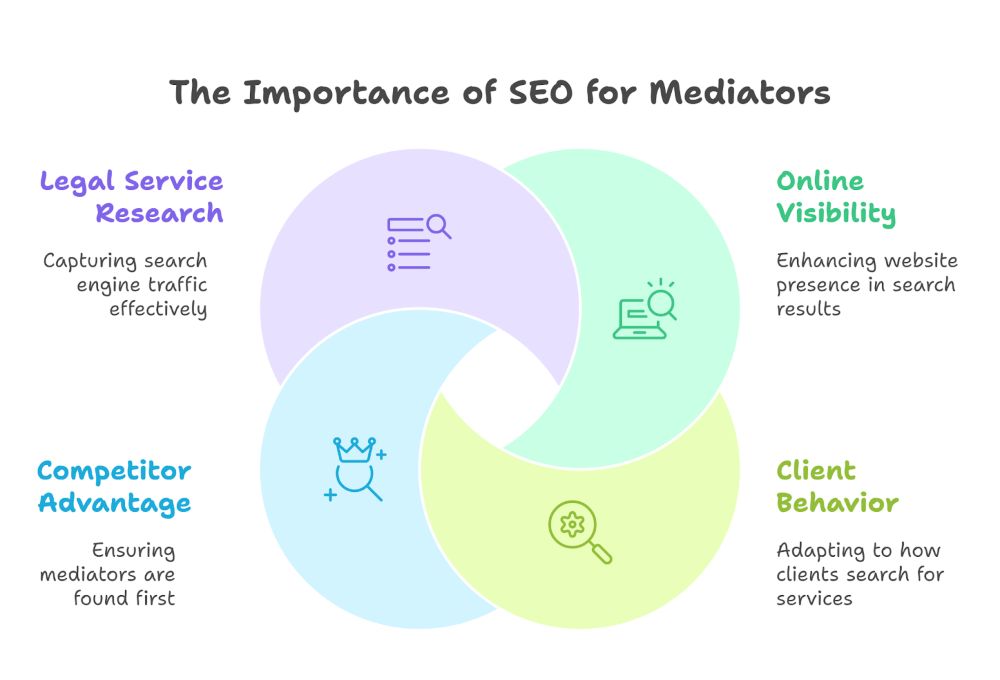
If your mediation practice isn’t showing up online, it might as well be invisible. When people need help resolving disputes, they turn to Google first.
SEO is your bridge—connecting you with clients at the exact moment they’re searching for guidance.
A well-optimized website ensures that when someone needs a mediator, they find you first—not your competitors.
The Shift Toward Online Search
When people face conflicts that require mediation, they increasingly turn to search engines first. SEO increases a website’s visibility so that potential clients can more readily find mediators.
This fundamental shift in client behavior means mediators must adapt their marketing strategies.
For legal mediators, this trend is particularly significant. Most clients conduct research before making contact, often comparing several options. Without proper SEO, mediator websites remain buried beneath competitors, regardless of the mediator’s expertise or qualifications.
The data shows that 96% of people seeking legal services use a search engine during their research process. Mediators who optimize their websites capture this traffic at the precise moment when clients are actively looking for solutions.
The Power of Credibility in SEO
SEO builds more than just visibility—it establishes authority. SEO shows authority, which is particularly valuable in mediation, where trust is paramount.
High-ranking websites are perceived as more credible by potential clients.
Content that addresses specific mediation topics demonstrates expertise. This might include:
- Articles on mediation processes
- Case studies (with anonymized details)
- FAQs addressing common client concerns
- Resources explaining mediation benefits
Attorney mediators face unique challenges but can leverage their dual expertise through targeted content strategies. They effectively differentiate themselves by creating resources showcasing legal knowledge and mediation skills.
Good SEO practices improve website structure, loading speed, and navigation. This improves the user experience and enhances perceived professionalism.
Competitive Advantage with SEO
The mediation market is increasingly competitive. SEO is a crucial component of any mediation attorney’s online marketing strategy. Those who invest in optimization gain significant advantages over competitors.
Local SEO is particularly powerful for mediators since most clients seek professionals in their geographic area.
Optimizing for location-specific keywords helps target the right audience. Consider these advantages:
- Targeted visibility in specific practice areas (divorce, business, workplace)
- Lower client acquisition costs compared to paid advertising
- Sustainable traffic that continues without ongoing ad spending
- Data-driven insights about potential client needs
Mediation SEO and traditional law firm SEO differ in addressing specific client emotions and situations.
Mediators should emphasize collaborative resolution in their keyword strategy and content rather than adversarial approaches.
Technical SEO – Foundation for High Rankings
Technical SEO creates the foundation for search engines to effectively find, crawl, and index your mediator website.
It’s the backbone that supports all your other SEO efforts and ensures clients can find you when they need mediation services.
Mobile Optimization & Site Speed
Mobile optimization is no longer optional for mediator websites. With over 60% of searches now happening on mobile devices, your site must perform flawlessly across all screen sizes.
Key mobile optimization factors:
- Responsive design that adapts to any device
- Large, tappable buttons (at least 44×44 pixels)
- Easy-to-read fonts (minimum 16px)
- Simplified navigation for touchscreens
Site speed directly impacts both rankings and client conversion rates. When potential clients need mediation services, they won’t wait for slow pages to load.
Speed improvement tactics:
- Compress all images before uploading
- Enable browser caching
- Minimize HTTP requests
- Use a content delivery network (CDN)
- Remove unnecessary plugins and scripts
Test your site speed regularly using Google’s PageSpeed Insights. Aim for a score above 80 on both mobile and desktop.
Secure Website (HTTPS)
HTTPS isn’t just about security—it’s a trust signal that shows potential mediation clients your site is legitimate and professional. Google has confirmed HTTPS as a ranking factor since 2014.
To implement HTTPS properly:
- Purchase an SSL certificate (many hosts offer free certificates)
- Install the certificate on your server
- Set up 301 redirects from HTTP to HTTPS versions
- Update internal links to HTTPS
- Update your site URL in the Google Search Console
This security layer protects sensitive client information that might be shared through contact forms on your mediator website. This protection is significant for professional service businesses where confidentiality matters.
Implementing Schema Markup for Mediators
Schema Markup helps search engines better understand your mediation services, potentially improving your site’s appearance in search results. For mediators, the right schema can significantly boost local visibility.
Essential schema types for mediators:
- LocalBusiness markup
- Professional Service markup
- Person markup (for mediator profiles)
- FAQ markup (for common mediation questions)
Adding schema markup helps Google create rich snippets that stand out in search results.
These enhanced listings can display your mediation specialty, business hours, reviews, and pricing information directly in search results.
Implementation options include JSON-LD (recommended by Google), Microdata, or RDFa. For non-technical mediators, plugins like Yoast SEO can help implement basic schema without coding knowledge.
Local SEO – Attracts Clients in Your Area
Local SEO helps mediators connect with clients in their specific geographic area by improving online visibility in local search results.
Implementing targeted strategies can significantly boost your practice’s visibility when potential clients search for mediation services nearby.
Google Business Profile Optimization
Mediators who want to improve their local visibility must create and optimize a Google Business Profile. This free tool serves as a digital storefront in Google’s ecosystem.
To maximize your GBP effectiveness:
- Use the category “Mediator” or “Mediation Service”
- Include your complete business name, address, and phone number
- Add business hours and services offered
- Upload professional photos of your office and team
- Create posts about mediation topics regularly (aim for weekly updates)
The profile should feature keywords like “certified mediator,” “family mediation,” or “divorce mediator,” where relevant. Ensure all information matches exactly what appears on your website to avoid confusing search engines and potential clients.
Local Citations & Legal Directories
Local citations build credibility and help search engines verify your business information. These mentions of your practice across the web strengthen your local search presence.
Key directories for mediators include:
- General directories: Yelp, Yellow Pages, BBB
- Legal-specific directories: Avvo, FindLaw, Martindale-Hubbell
- Mediation-specific directories: Mediate.com, ADR Times
Consistency is crucial—ensure your name, address, and phone number (NAP) appear identically across all platforms. This consistency helps search engines recognize your business as legitimate and trustworthy.
Local chambers of commerce and bar association memberships also create valuable citation opportunities that establish local authority in the mediation field.
Leveraging Online Reviews for SEO
Reviews significantly impact both local search visibility and client acquisition. Positive reviews signal to search engines that your mediation service is reputable and relevant.
Effective review strategies include:
- Creating a simple process for satisfied clients to leave reviews
- Sending follow-up emails with direct links to your Google Business Profile
- Responding professionally to all reviews—both positive and negative
Never purchase fake reviews, as this violates Google’s policies and can result in penalties. Instead, focus on providing excellent service and making the review process convenient for clients.
Google particularly values recent, authentic reviews that mention specific services. Reviews containing keywords like “family mediator” or “business dispute mediation” provide additional SEO value while helping potential clients understand your areas of expertise.
Want your mediation practice to stand out online? 800Commerce specializes in SEO for mediators, helping you rank higher, attract more clients, and grow your business. Get a free consultation today!
Keyword & Content Strategy for Mediators
An effective SEO strategy for mediators requires carefully selected keywords and compelling content that resonates with potential clients seeking mediation services.
This foundation drives qualified traffic to your website and converts visitors into clients.
Finding High-Intent Keywords
Mediators must focus on keywords that indicate a strong intention to hire mediation services. These high-intent keywords help attract qualified leads rather than casual browsers.
Start with location-specific terms like “divorce mediator in [city]” or “family mediation services [location].” These local keywords often have less competition than general terms.
Look for long-tail keywords such as “how to resolve business partnership disputes without litigation” or “peaceful custody mediation process.” These phrases show clear intent and specific needs.
Tools like Google Keyword Planner, Semrush, or Ahrefs can reveal search volume and competition levels. Mediators should also analyze the keywords competing law firms and other mediators target.
High-Value Keyword Categories for Mediators:
- Divorce mediation terms
- Business dispute resolution
- Family conflict mediation
- Employment mediation services
- Civil case mediation
Creating Content That Converts
Valuable, informative content is crucial for mediator websites. Each piece should address specific client pain points and position the mediator as an authority.
Case studies demonstrating successful mediation outcomes (with anonymized details) build trust with potential clients. These stories should highlight the mediator’s process and expertise.
FAQ pages answering common questions like “How long does mediation take?” or “Is mediation legally binding?” address concerns directly. These pages also naturally incorporate important keywords.
Blog posts should focus on educational topics such as “5 Benefits of Choosing Mediation Over Litigation” or “What to Expect in Your First Mediation Session.” These articles establish expertise while targeting relevant search terms.
Content should always include clear calls to action, encouraging readers to schedule consultations or learn more about services.
Video Content for Engagement
Video content significantly enhances a mediator’s online presence and SEO effectiveness. Search engines favor websites with varied content types, and videos increase the time spent on the site.
Short explainer videos about the mediation process make complex topics accessible. These can address concerns like “What happens during divorce mediation?” or “How mediation saves money compared to litigation.”
Client testimonial videos (with permission) build credibility and trust. Seeing real people discuss positive experiences resonates more deeply than written reviews.
Educational webinars on conflict resolution topics can be repurposed across multiple platforms. The mediator should optimize video titles and descriptions with relevant keywords.
Video transcripts should be included on the website to make content accessible and provide additional SEO benefits. These transcripts give search engines more text to index.
Link Building – Strengthening SEO Authority
Link building is one of the most powerful ways to boost your mediator website’s authority in search engines. When other reputable websites link to yours, Google sees this as a vote of confidence in your content.
High-Authority Backlinks
Mediators can rank #1 on Google without spending a fortune by focusing on quality backlinks rather than quantity.
Start by getting listed in mediator directories and professional organizations relevant to your specialty.
Guest posting on legal blogs gives you exposure to potential clients while earning valuable backlinks.
Consider contacting law schools, courts, and community organizations that link to your resources.
When competing against lawyer websites, focus on your specialized knowledge. Create comprehensive mediation guides that law firms might reference and link to.
This builds authority through backlinks, which can help mediators outrank general legal websites.
Remember that link building is about quality, not just about accumulating links. One backlink from a respected legal journal carries more weight than dozens from irrelevant sites.
Internal Linking Best Practices
Internal linking creates pathways for both users and search engines to navigate your site effectively. Every mediator service page should link to related content, creating a web of information that keeps visitors engaged.
Use descriptive, keyword-rich anchor text for internal links rather than generic “click here” phrases. For example, link phrases like “divorce mediation process” or “workplace conflict resolution.”
Structure your internal links to create topic clusters around your primary services. For example, a main page about “Family Mediation” might link to specific pages about child custody mediation, divorce mediation, and elder care mediation.
According to SEO experts, search engines view these internal links as signals about your site structure and content relationships.
This helps Google understand your specialty areas, potentially helping you rank higher than general legal sites for mediation-specific searches.
Is your website bringing in the clients you deserve? We optimize your site with 800Commerce’s Local SEO services to dominate search results and increase inquiries. Let’s boost your visibility now!
Measuring SEO Success for Mediators
Tracking the right metrics helps mediators understand if their SEO efforts are working. Effective measurement allows for data-driven decisions that optimize website performance and attract more potential clients.
SEO Performance Metrics
Organic Traffic is perhaps the most important metric for mediator websites. Monitor the number of visitors coming to your site through Google Analytics search engines. A steady increase suggests your SEO strategy is working.
Keyword Rankings show how well your website appears in search results for target terms like “divorce mediator” or “family mediation services.” Track your positions for important keywords that potential clients use to find mediation services.
Conversion Rates measure how many visitors take desired actions on your site:
- Completing contact forms
- Scheduling consultations
- Downloading mediation resources
- Calling your office
Bounce Rate indicates how many visitors leave without engaging with your site. High bounce rates might suggest your content isn’t meeting visitor expectations or your site loads too slowly.
Analyzing & Adjusting SEO Strategy
Regular SEO Audits help identify technical issues that may hinder performance. Mediators should review site speed, mobile-friendliness, and broken links quarterly to maintain optimal site health.
Content Performance Analysis reveals which mediation topics resonate with potential clients. Review which pages attract the most traffic and engagement, then create similar content to build on that success.
Competitor Benchmarking provides context for your metrics. Compare your site’s performance against other mediators in your area to identify opportunities for improvement.
When metrics show underperformance, make targeted adjustments rather than overhauling your entire strategy. Small changes to titles, headings, and content often yield significant improvements in rankings and traffic.
Common SEO Mistakes Mediators Should Avoid
Mediators who want effective websites must avoid critical SEO errors that could prevent potential clients from finding their services.
Even small mistakes can significantly impact your visibility in search results and reduce the number of leads your practice receives.
Ignoring Local SEO
Many mediators make the mistake of not optimizing for local search queries. Since mediation services are typically location-based, this oversight can be costly.
Essential local SEO elements include:
- Google Business Profile with accurate business information
- Local keywords (e.g., “divorce mediator in Chicago”)
- Location-specific pages for mediators serving multiple areas
- Local business schema markup
Failing to gather positive reviews from satisfied clients also hurts local rankings. Research shows that 87% of potential clients read online reviews before selecting a mediator.
Don’t overlook local directories and legal service listings that can improve your visibility. These citation sources help search engines verify your business information and boost confidence in your legitimacy.
Not Updating Website Content
Static, outdated content is a major SEO mistake for mediators. Search engines favor websites that regularly publish fresh, relevant content.
Content that needs regular updates:
- Blog posts addressing common mediation questions
- Case studies (with client permission and anonymized)
- Changes in mediation laws or procedures
- Service offerings and pricing information
Many mediators copy competitors’ content without improvement, which search engines penalize as duplicate content. Instead, create original content that demonstrates your unique expertise and approach.
Content should align with user intent—what potential clients are actually searching for. Focus on addressing common client questions rather than just promoting your services.
Overlooking Website Speed & Security
Legal professionals frequently neglect technical SEO factors like site speed and security. Slow-loading websites frustrate visitors and signal poor quality to search engines.
Speed improvements mediators should implement:
- Image optimization (proper sizing and compression)
- Minimal use of heavy plugins and scripts
- Content Delivery Network (CDN) implementation
- Mobile-responsive design
Security is equally important. Lacking an SSL certificate (https://) creates trust issues and can trigger browser warnings that drive away potential clients.
Most mediators underestimate the time required for SEO improvements to show results. Technical fixes may deliver quick wins but expect most SEO efforts to take 3-6 months before significant ranking improvements appear.
Conclusion
Implementing effective SEO strategies can transform a mediator’s online presence. Mediators focusing on technical and content-based optimization position themselves to attract more potential clients.
The most successful mediator websites combine local SEO techniques with quality content that addresses client concerns. This balanced approach helps mediators stand out in a competitive digital landscape.
Building a strong backlink profile remains essential. Mediators who secure quality links from reputable sites can improve their rankings in search results, making them more visible to people seeking mediation services.
Regular website maintenance and content updates signal to search engines that a mediator’s site is relevant and active. This ongoing attention helps maintain and improve search rankings over time.
Mobile optimization cannot be overlooked. Since most searches occur on mobile devices, so mediator websites must function flawlessly across all screen sizes.
Analytics tracking provides valuable insights into website performance. Smart mediators use this data to refine their SEO strategies and better meet potential clients’ needs.
The digital landscape continues to evolve, but the fundamentals of SEO for mediators remain consistent: provide value, establish expertise, and make information accessible. Mediators who commit to these principles will continue to attract clients who need their services.
Don’t let potential clients choose your competitors. 800Commerce’s SEO solutions ensure your mediation services get found by the right people at the right time. Contact us today and take the lead!
Frequently Asked Questions
What is SEO for mediators?
SEO for mediators is the process of optimizing a mediation practice’s website to rank higher on search engines like Google. This includes local SEO, keyword optimization, content marketing, and technical improvements to attract more clients online.
How can mediators improve their Google rankings?
Mediators can improve Google rankings by:
- Optimizing Google Business Profile with accurate details and client reviews.
- Using relevant keywords like “divorce mediation near me.”
- Creating informative blog content to answer common client questions.
- Building backlinks from trusted legal directories.
Why is local SEO important for mediators?
Local SEO ensures your mediation services appear when potential clients search for “mediator near me” or similar terms. 46% of all Google searches have local intent, making Google Business Profile, location-based keywords, and local citations essential for ranking higher.
What are the best keywords for mediation SEO?
The best SEO keywords for mediators include:
- “Divorce mediation near me”
- “Best workplace mediator [city]”
- “Family dispute resolution expert”
- “Mediation vs. litigation cost comparison”
Using long-tail keywords helps attract high-intent clients looking for mediation services.
How do reviews impact SEO for mediators?
Reviews boost local SEO rankings by increasing trust and engagement. 87% of users read online reviews before choosing a service. Encouraging satisfied clients to leave detailed, keyword-rich reviews on Google and legal directories can improve visibility.
What role does content play in mediator SEO?
High-quality content helps mediators rank for more keywords and build credibility. Blogging about common disputes, legal mediation tips, and industry updates attracts visitors and improves search rankings. Websites with consistent content get 55% more traffic than those without.
How long does it take for SEO to show results for mediators?
SEO is a long-term strategy. Most mediators see noticeable ranking improvements in 3-6 months, but consistent content updates, link building, and technical SEO adjustments are necessary for continued growth.