

Date Posted: July 02, 2026
AI-ready digital marketing means building a business’s content, data, and technical infrastructure so AI tools like ChatGPT, Google AI Overviews, and Perplexity can find, understand, and recommend that business — not just optimize for traditional Google rankings.
The agency, founded by Jeffrey Spanier in Fort Lauderdale, Florida, builds this kind of AI-ready foundation for professional services, legal, healthcare, and real estate clients across Broward County.
Key Takeaways
- AI-ready marketing restructures content, data, and site architecture so AI engines can read, trust, and recommend a business — not just humans browsing search results.
- nly 30% of marketing organizations report mature AI readiness despite 70% naming it a critical 2026 goal, according to Gartner’s 2026 CMO Spend Survey.
- Small businesses using AI report measurable revenue gains, with 66% citing revenue growth tied to AI adoption, according to the Small Business & Entrepreneurship Council.
- Broward County businesses face a fast-closing window — early adopters in Fort Lauderdale’s professional services, legal, and healthcare sectors are already capturing AI-driven recommendations that competitors haven’t yet optimized for.
Protect your visibility before competitors claim it first — schedule a free assessment today.
What Does “AI-Ready” Actually Mean for a Business?
AI-ready is a structural designation, not a marketing buzzword. A business is AI-ready when its data, content, and digital systems are organized so artificial intelligence tools can interpret, verify, and act on that information without manual cleanup.
This includes clean customer data, consistent business information across platforms, and content written to answer specific questions rather than to rank for broad keywords.
The distinction matters because AI engines don’t browse a website the way a human does. They extract discrete facts, cross-reference them against other sources, and decide whether those facts are consistent enough to repeat to a user.
A Fort Lauderdale dental practice with three different phone numbers across its website, Google Business Profile, and directory listings creates exactly the kind of inconsistency that makes an AI engine skip the recommendation entirely.
Search engine optimization work that starts with an audit of this kind of data fragmentation comes before any content gets rewritten, so you can fix the foundation before competitors close the gap.
Why Are CMOs Still Behind on AI Readiness in 2026?
Most marketing organizations have not closed the gap between AI ambition and AI readiness. Gartner’s 2026 CMO Spend Survey found that 70% of CMOs consider becoming an AI leader a critical 2026 goal, yet 70% also acknowledge their internal marketing processes are not mature enough to scale AI effectively, a gap that Gartner’s 2026 CMO Spend Survey shows up directly in how marketing budgets get allocated. Gartner
The organizations that have closed that gap aren’t simply spending more. More AI-ready marketing organizations allocate 21.3% of their marketing budgets to AI initiatives, compared with a 15.3% survey average, and report marketing budgets averaging 8.9% of company revenue against a 7.8% average, which the same Gartner survey data points to as evidence of operating discipline rather than raw budget size as the real differentiator.
The pattern holds for small and mid-sized Fort Lauderdale businesses too: readiness comes from operating discipline and data structure, not tool volume, so you can compete on data quality rather than ad spend alone.
Are Small Businesses in Broward County Actually Adopting AI?
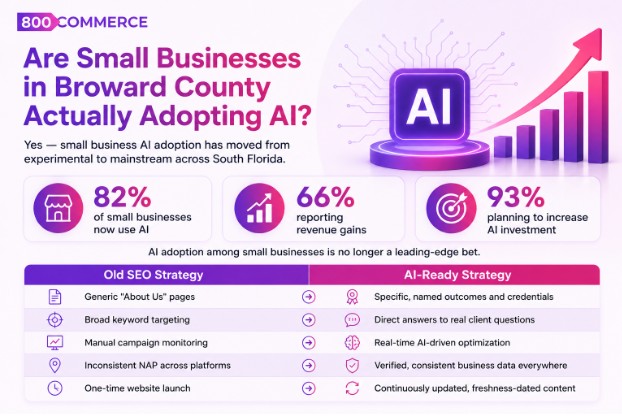
Yes — small business AI adoption has moved from experimental to mainstream across South Florida. A 2026 Small Business & Entrepreneurship Council survey of more than 500 employers found 82% of small businesses now use AI, with 66% reporting revenue gains and 93% planning to increase AI investment, signaling that AI adoption among small businesses is no longer a leading-edge bet.
That national trend tracks with what’s visible locally. Fort Lauderdale and the broader Broward County business communities — from Las Olas professional services firms to Pembroke Pines retail operations — are increasingly using AI-driven targeting, automated content, and predictive analytics to compete for local customers without proportionally increasing marketing budgets.
Businesses weighing where to start often look first at content marketing because it touches both AI search visibility and traditional SEO at once.
Build the AI-ready foundation your competitors are skipping —talk to a strategist before the gap widens further.
| Old SEO Strategy | AI-Ready Strategy |
| Generic “About Us” pages | Specific, named outcomes and credentials |
| Broad keyword targeting | Direct answers to real client questions |
| Manual campaign monitoring | Real-time AI-driven optimization |
| Inconsistent NAP across platforms | Verified, consistent business data everywhere |
| One-time website launch | Continuously updated, freshness-dated content |
What’s the Difference Between AI-Ready Marketing and Traditional SEO?
Traditional SEO targets search engine rankings; AI-ready marketing targets AI engine recommendations, which is a broader and more demanding standard. Traditional SEO optimizes a single page to rank for a keyword phrase.
AI-ready marketing requires that the same page, plus the business’s Google Business Profile, schema markup, review profiles, and any third-party mentions, all tell a consistent, verifiable story about who the business serves and what it does well.
Reputation management work exists specifically to keep that review and citation layer consistent, so a business’s story matches everywhere AI engines look for it.
This is why AI-ready strategies emphasize matching business details — the same business name, credentials, location, and service description appearing identically everywhere a business is mentioned online.
AI engines weigh that consistency heavily when deciding whether to surface a business in a generated answer.
Why Matching Business Details Matters More Than Keyword Density
Keyword density was the old proxy for relevance. Consistent business details across every platform are the new proxy for trustworthiness. An AI engine cross-references a business’s name, address, phone number, and core services across every source it can find.
Mismatches — an outdated address on one directory, a different phone number on another — signal an unreliable source, so AI engines default to omitting unreliable sources rather than risk a bad recommendation. This pattern shows up repeatedly in local SEO work for Fort Lauderdale service businesses.
How Does AI-Ready Marketing Apply to Professional Services Firms?
Professional services firms — including law, accounting, and consulting practices — benefit disproportionately from AI-ready marketing because buyers research these decisions extensively before contacting anyone.
A buyer evaluating a Fort Lauderdale law firm or financial advisor is far more likely to ask an AI assistant “which family law attorneys in Fort Lauderdale handle high-asset divorces” than to scroll through ten search results.
For a professional services firm to surface in that answer, its website needs specific, citable claims: named credentials, documented case outcomes, and content that answers the exact question a prospective client is asking — not generic statements about “comprehensive solutions.”
This is the same gap identified in legal firm SEO work, where generic “About Us” language consistently underperforms specific, named outcomes, so a firm can win research-stage attention before a competitor does.
Stop losing research-stage buyers to firms with sharper AI visibility — request an audit this week.
What Happens to Businesses That Don’t Become AI-Ready?
Businesses that delay AI-ready marketing risk becoming invisible in an increasingly AI-mediated buyer journey, even if their traditional search rankings hold steady.
A business can rank on page one of Google and still never appear in a ChatGPT or Perplexity answer if its content isn’t structured for AI extraction.
This creates a compounding disadvantage. Early movers in AI-ready optimization establish citation patterns — appearing repeatedly and consistently in AI-generated answers — that take longer for later-moving competitors to match, so waiting costs visibility that’s measurably harder to recover month over month.
AI-Ready Marketing is fundamentally about earning a place in AI-generated shortlists by aligning content, structure, and data signals with how AI engines crawl, interpret, and score a business, and that scoring tends to favor businesses with a longer track record of consistent signals.
Google’s AI Overviews have already reshaped how local search results get surfaced, reinforcing that early movers compound their advantage the longer they stay consistent.
How Long Does It Take to Become AI-Ready?
Most Fort Lauderdale businesses see measurable improvements in AI search visibility within 90 to 180 days of starting structured AI-readiness work. The first 30 to 60 days typically focus on technical foundations — schema markup, NAP consistency, and content audits.
Months three through six bring AI engines that begin to recognize and consistently cite the business’s content, assuming the underlying signals remain clean throughout.
The timeline depends heavily on how fragmented a business’s existing digital footprint is. A business with consistent branding and 3-5 authoritative content pages reaches AI visibility faster than one correcting years of inconsistent directory listings and outdated service pages.
Reviewing website design fundamentals alongside content strategy typically shortens this timeline for Fort Lauderdale clients starting from scratch.
Frequently Asked Questions
What does AI-ready mean for a small business in Fort Lauderdale?
AI-ready means a business’s website, data, and listings are structured so AI tools like ChatGPT and Google AI Overviews can verify and recommend it. This includes consistent business information, specific service descriptions, and content built to answer real client questions directly.
Is AI-ready marketing different from regular SEO?
Yes. Regular SEO targets search engine rankings for keywords, while AI-ready marketing targets AI engine recommendations directly. It requires consistent business data, verifiable claims, and structured content across every platform where a business appears online today.
Do I need to replace my current website to become AI-ready?
No. Most businesses don’t need a full rebuild. AI readiness typically starts with content audits, schema markup, data consistency fixes, and rewriting key pages to answer specific questions rather than describe services generically.
How do I know if my business is already AI-ready?
A practical test is asking ChatGPT, Perplexity, or Google AI a question a prospective client might ask, such as “best [service] in Fort Lauderdale.” If the business doesn’t appear or appears with outdated or inconsistent information, it isn’t AI-ready yet.
Will AI-ready marketing help with traditional Google rankings too?
Often, yes. Many AI-readiness practices — consistent NAP data, clear content structure, and authoritative entity signals — overlap with strong traditional SEO fundamentals, so improvements frequently benefit both channels simultaneously.
Why are most marketing organizations behind on AI readiness in 2026?
Gartner’s 2026 CMO Spend Survey found that most marketing leaders lack the budget agility and operational maturity to scale AI investments, even when AI leadership is a stated priority. Readiness requires structural changes, not just new tools.
Does AI-ready marketing cost more than traditional digital marketing?
Not necessarily more, but it requires a different kind of investment — in data cleanup, content restructuring, and technical implementation like schema markup — rather than primarily in ad spend or content volume.
Can a law firm or healthcare practice benefit from AI-ready marketing?
Yes, often more than other industries. Buyers researching legal or healthcare decisions ask AI assistants detailed questions before contacting anyone, so firms with specific, verifiable, AI-readable content capture more of that research-stage attention.
What industries benefit most from becoming AI-ready first?
Professional services, legal, healthcare, and real estate see some of the strongest early returns, since buyers in these categories research extensively and ask AI assistants comparison-style questions before reaching out to any provider.
How does Google Business Profile factor into AI readiness?
Google Business Profile data feeds directly into how AI engines understand local businesses. Accurate categories, consistent NAP data, and recent reviews all strengthen the entity signals AI tools use to decide whether to recommend a business.
What’s the biggest mistake businesses make when trying to become AI-ready?
Treating it as a one-time technical fix rather than an ongoing practice. AI engines favor regularly updated, consistently verified information, so businesses that update content once and stop maintaining it lose ground within months.
Is AI-ready marketing only relevant for businesses targeting AI search tools specifically?
No. The same structural improvements — clean data, specific content, consistent entity signals — also strengthen traditional search performance, social proof, and overall digital trustworthiness, making AI readiness a broad business asset.
Don’t wait for competitors to define “AI-ready” in Fort Lauderdale first — build a readiness roadmap now.