
x


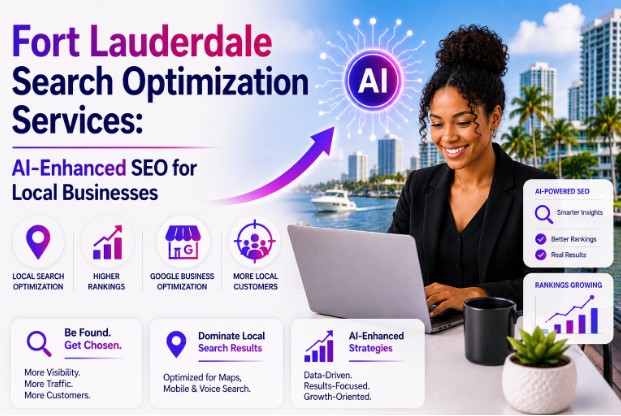
Fort Lauderdale SEO services in 2026 require three disciplines working together — traditional search engine optimization, Generative Engine Optimization (GEO), and Answer Engine Optimization (AEO) — to capture visibility across Google, AI Overviews, ChatGPT, and Perplexity simultaneously.
800Commerce, a Fort Lauderdale, Florida digital marketing agency founded by Jeffrey Spanier, combines all three into a unified content marketing and search strategy built for the AI era, so Fort Lauderdale businesses can appear wherever prospective customers search — not just where they used to.
Ranking on Google is no longer enough when AI answers capture the click first — schedule an audit with 800Commerce today.
AI-enhanced SEO is search engine optimization that accounts for AI-generated answers — not just traditional blue-link rankings — across every platform where Fort Lauderdale buyers research products and services.
Gartner’s 2026 CMO Spend Survey found that 70% of CMOs call AI leadership a critical goal, while 70% acknowledge their organizations lack the maturity to scale AI effectively, a readiness gap that shows up directly in how Fort Lauderdale businesses compete for search visibility.
Traditional SEO alone targets only half the discovery surface buyers now use. AI-enhanced SEO closes that gap by optimizing content for both ranked results and AI-generated AI Overviews answers, so a Fort Lauderdale business appears in the AI summary at the top of the page rather than buried below it.

Traditional SEO, GEO, and AEO are three distinct disciplines that target different discovery surfaces — and Fort Lauderdale businesses competing in 2026 need all three. Each addresses a different layer of how AI and search engines present information to users.
Discipline | What It Targets | Key Signals | Platforms |
Traditional SEO | Organic blue-link rankings | Keywords, backlinks, technical health, page speed | Google, Bing |
GEO (Generative Engine Optimization) | AI-generated summaries and overviews | Entity consistency, structured data, passage-level answers, schema markup | Google AI Overviews, Gemini |
AEO (Answer Engine Optimization) | Direct answers in conversational AI tools | Named credentials, verifiable statistics, cited sources, self-contained passages | ChatGPT, Perplexity, Claude, voice assistants |
800Commerce builds Fort Lauderdale SEO campaigns that integrate all three, so a business’s content ranks organically, appears in AI-generated summaries, and gets cited by conversational AI search tools — capturing leads across every discovery channel rather than optimizing for one while losing ground on the others.
Google AI Overviews now trigger on approximately 48% of all tracked queries, according to BrightEdge’s February 2026 data — a 58% increase year over year — and the average AI Overview exceeds 1,200 pixels in height, pushing the first organic result below the fold.
BrightEdge’s one-year analysis found that only 17% of sources cited in AI Overviews also rank in the organic top 10 for the same query, which means 5 out of 6 AI citations pull from content that isn’t on page one of traditional results.
Fort Lauderdale businesses that rely solely on traditional rankings lose visibility whenever Google serves an AI summary above their listings.
800Commerce’s GEO strategy structures content at the passage level — 40- 120-word self-contained answer blocks with named entities, specific credentials, and verifiable claims — so AI engines can extract and cite that content directly in their generated answers.
An AI-era SEO strategy for Fort Lauderdale combines technical SEO foundations with entity optimization, E-E-A-T signaling, structured content architecture, and local market targeting across both traditional and AI search surfaces.
800Commerce’s campaigns for Fort Lauderdale businesses include Google Business Profile optimization with active review management, schema markup for every service page and FAQ, entity binding that connects business name, credentials, location, and practice area consistently across every platform, and content structured for AI passage extraction rather than keyword density alone.
Competitors already optimizing for AI search are capturing leads your traditional SEO strategy never sees — let 800Commerce show you the visibility gap.
800Commerce tracks AI citation share — how often a business appears in AI-generated answers across ChatGPT, Perplexity, and Google AI Overviews — alongside traditional metrics like organic traffic, keyword rankings, and conversion rates.
This dual-layer reporting shows Fort Lauderdale business owners exactly where they appear and where they don’t, so optimization efforts target the highest-value gaps first rather than improving vanity metrics.
Reputation management signals — review volume, review sentiment, and response rate — feed directly into both traditional and AI ranking factors, which is why 800Commerce monitors review performance as a search visibility metric, not just a branding exercise.
Healthcare, legal services, professional services, and home services see the strongest returns from AI SEO in Fort Lauderdale because buyers in these categories research extensively through AI tools before contacting any provider.
BrightEdge’s industry data shows healthcare queries trigger AI Overviews on 88% of tracked searches — the highest of any industry — followed by education at 83% and B2B technology at 82%.
Industry | AI Overview Presence (Feb 2026) | Top-10 Citation Overlap |
Healthcare | 88% | 24% |
Education | 83% | 19% |
B2B Technology | 82% | 22% |
Restaurants | 78% | 16% |
Insurance | 63% | 22% |
Fort Lauderdale businesses in high-AIO industries that lack GEO and AEO optimization are invisible in exactly the searches where buyers are most active.
800Commerce applies the same local SEO infrastructure it builds for Broward County professional services clients — entity binding, jurisdiction naming, named-practitioner attribution — to every industry where AI search drives buyer decisions.
Most Fort Lauderdale businesses see measurable improvements in organic traffic and AI citation share within 90 to 180 days of starting structured AI SEO work.
The first 60 days typically focus on technical foundations — schema markup, entity consistency, NAP corrections across directories, and website design audits that identify structural barriers to AI extraction.
Months three through six bring AI engines that begin to recognize and consistently cite the business’s content.
The timeline depends heavily on how fragmented a business’s existing digital footprint is, since cleaning up years of inconsistent directory listings takes longer than building a clean foundation from scratch.
SEO optimizes a website to rank in traditional search engine results. GEO — Generative Engine Optimization — structures content for AI-generated answers in tools like Google AI Overviews. AEO — Answer Engine Optimization — targets direct answers in ChatGPT, Perplexity, and voice assistants.
AI Overviews appear above traditional search results, pushing organic listings below the fold. Fort Lauderdale businesses that don’t optimize for AI Overviews lose visibility even when they rank on page one, since the AI-generated summary captures the click before users scroll down.
Most Fort Lauderdale businesses see measurable improvements in organic traffic and AI citation share within 90 to 180 days of starting structured AI SEO work. Technical foundations like schema markup and entity optimization typically produce initial signals within the first 60 days.
Yes. BrightEdge data shows only 17% of sources cited in AI Overviews also rank in the organic top 10. A page-one ranking does not guarantee inclusion in AI-generated answers, which means GEO addresses a visibility gap that traditional SEO alone cannot close.
Healthcare, legal services, professional services, and home services see the strongest returns from AI SEO in Fort Lauderdale because buyers in these categories research extensively through AI tools before contacting any provider, making AI citation share a direct driver of lead volume.
AI-enhanced SEO retainers for Fort Lauderdale businesses typically range from $1,500 to $5,000 per month, depending on scope, competitive intensity, and whether the engagement includes GEO, AEO, and traditional SEO together or targets one discipline at a time as a standalone service.
Yes, and they should. Traditional SEO builds the ranking foundation that AI engines reference when selecting citation sources. GEO and AEO layer structured content, entity data, and passage-level optimization on top of that foundation to capture AI-generated answer placements simultaneously.
Entity optimization ensures a business’s name, credentials, location, and services appear consistently across every platform AI engines reference. AI tools cross-check entity data before recommending a business, so inconsistencies between a website, directory listings, and review profiles reduce citation likelihood.
800Commerce tracks AI citation share — how often a business appears in AI-generated answers across ChatGPT, Perplexity, and Google AI Overviews — alongside traditional metrics like organic traffic, keyword rankings, and conversion rates, reporting both in a unified monthly dashboard.
Yes. 800Commerce serves clients across South Florida and nationally, though the agency’s deepest market expertise and strongest case history cover Fort Lauderdale, Broward County, Miami-Dade, and Palm Beach County, where local search patterns, seasonal tourism dynamics, and competitive landscapes are thoroughly documented.
Every AI-generated answer that skips your business sends a patient, client, or customer to a competitor — talk to 800Commerce about closing that gap now.